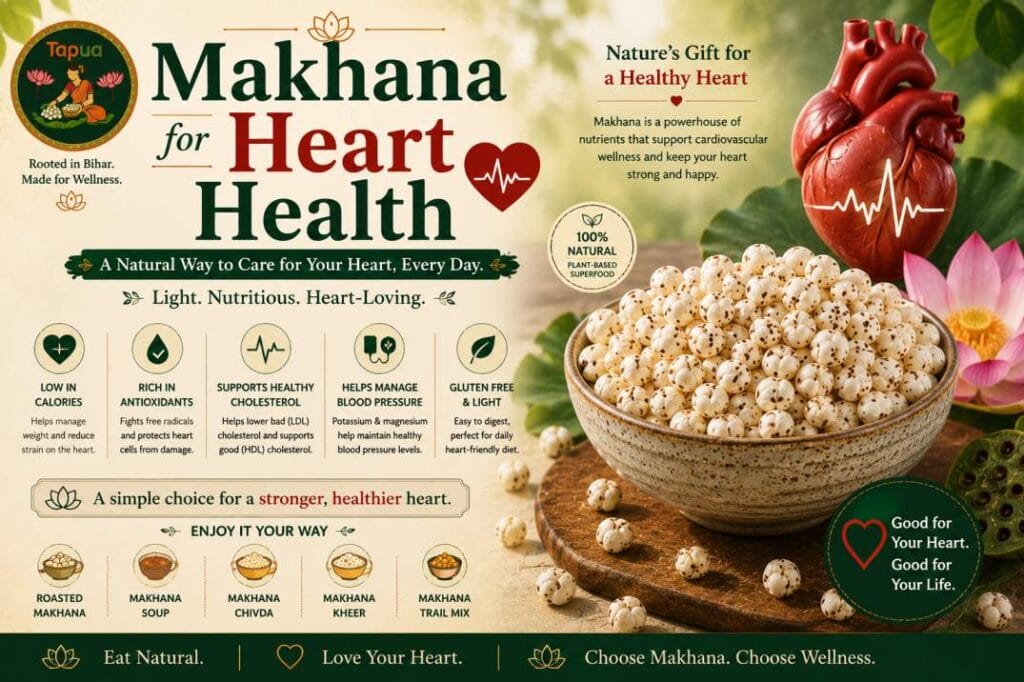
Search “makhana for heart health” and most of what comes back reads like the conclusion was decided before any research got cited: makhana gets called heart-healthy, then a list of high-fibre, high-protein foods follows as though that settles it. The real picture is narrower and, honestly, more interesting. A couple of animal studies have looked directly at makhana and cholesterol, and they found something worth paying attention to. Not yet something proven in people, just worth paying attention to.
This post goes through what those studies actually measured, what makhana’s everyday nutrients contribute on their own, and where the line sits between a promising lab result and a confirmed human benefit. None of it replaces a cardiologist’s advice, and none of it should be read as a treatment claim for an existing heart condition.
The Animal Studies Behind the Heart Claim
In 2019, researchers gave makhana seed extract to rats that had been fed a diet designed to cause non-alcoholic fatty liver disease. Over four weeks, the rats receiving the extract showed lower total cholesterol and lower triglycerides than the untreated group. A second study, this time in diabetic mice, reported a similar improvement in cholesterol markers after makhana supplementation. Both are real, peer-reviewed findings, and both point in a direction worth taking seriously.
What neither study did is test makhana on a human heart. The doses were concentrated extracts, not a snack-sized bowl, and the subjects were rodents with induced liver or metabolic disease, not an average adult eating roasted makhana three evenings a week. That gap between the lab result and your kitchen table is exactly where most “superfood” claims quietly go wrong.
What This Doesn’t Prove Yet
Healthline’s own review of makhana research is upfront about this: human studies are lacking, and while the animal data is suggestive, nobody has yet run a clinical trial on people with high cholesterol or heart disease. The proposed mechanism, antioxidant and anti-inflammatory compounds reducing oxidative stress in blood vessels, is biologically plausible. Plausible is not the same as confirmed, and a snack should not be mistaken for a substitute for a cardiologist’s plan.
The Nutrients That Hold Up Without the Cholesterol Claim
Set the extract studies aside and makhana still has a reasonable case for a heart-conscious diet, just a more modest one. Plain roasted Tapua makhana carries calcium and magnesium, both involved in maintaining healthy blood pressure. It’s naturally low in fat and, when roasted plain rather than in a heavy coat of ghee and salt, low in sodium too. Add the fibre content, around 14.5g per 100g, and you get a snack that fills you up without the saturated fat or sodium load of most fried namkeen.
Where Makhana Realistically Fits in a Heart-Conscious Diet
The most defensible heart-health angle for makhana isn’t a cholesterol-lowering claim, it’s a swap. Replace a handful of fried chips or salted namkeen with a bowl of plain roasted makhana, and you’ve cut fat and sodium without losing the satisfaction of a crunchy snack. A 30g portion, roasted in a teaspoon of ghee at most, fits comfortably into most heart-conscious eating patterns recommended by dietitians. It doesn’t undo a poor diet elsewhere, and it isn’t a stand-in for medication if you’ve already been diagnosed with high cholesterol or heart disease.
What This Doesn’t Mean
It doesn’t mean makhana lowers your cholesterol the way a statin does. It doesn’t mean you can skip a prescribed medication because you’ve added a snack to your diet. And it doesn’t mean every claim attached to fox nuts online is backed by the same level of evidence, some of it is animal data dressed up as settled science. If you have an existing heart condition or high cholesterol, talk to your doctor about where snacks like this fit into your actual treatment plan, rather than relying on a blog post to decide for you.
What People Want to Know
Does makhana actually lower cholesterol?
In animal studies using concentrated extract, yes, cholesterol and triglycerides dropped. In humans, this hasn’t been tested in a clinical trial yet, so the honest answer is that it’s promising, not proven.
Can heart patients eat makhana every day?
Plain roasted makhana in moderate portions is generally considered a reasonable snack for most people, including those managing heart conditions, but anyone with a diagnosed condition should check with their doctor first, especially around sodium if it’s seasoned heavily.
Is makhana better than other snacks for heart health?
Compared to fried, salted, or sugary snacks, plain roasted makhana is a lower-fat, lower-sodium option. Compared to something like a handful of walnuts, the evidence for heart benefits is currently weaker and less direct.
Does roasting makhana in ghee cancel out any heart benefit?
A teaspoon of ghee for a 30g portion isn’t going to undo much. A pan swimming in ghee and salt, eaten daily, starts working against the swap you were trying to make in the first place.
How much makhana counts as a heart-healthy serving?
Around 30g, roughly a cup of popped makhana, is the portion size used in most nutrition breakdowns and a reasonable amount to treat as one snack serving.
Tapua makhana is grown in the wetland ponds around a village of the same name in Mithila, and nothing about that origin changes a single cholesterol number. What it does mean is that the plain, lightly roasted bowl on your counter started somewhere specific, which is a nicer thing to know even if it isn’t a reason to eat it on its own.