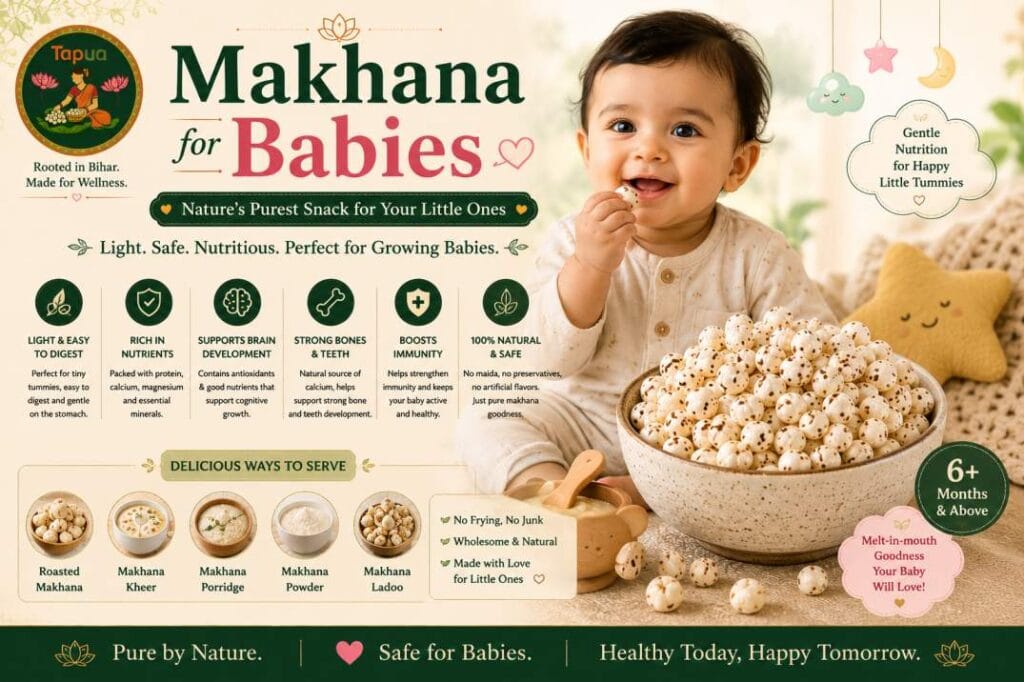
A jar of mashed sweet potato, a teething biscuit, and now a bowl of fox nuts on the counter: weaning introduces a lot of new foods fast, and parents want to know which ones are actually fine before they hand a baby a spoonful. Makhana keeps showing up on “first foods” lists because it turns soft once cooked, has almost no flavor of its own, and is easy to digest. The specifics of when and how matter more than a blanket yes, so this guide walks through the safe starting age, how to prepare it differently at each stage, and what to leave out until your baby is older.
When Can Babies Start Eating Makhana?
Most pediatric guidance points to around six months as the general window for introducing solids, alongside continued breast milk or formula, and makhana fits within that timeline once a baby is already managing other soft, mashed foods without trouble. There is nothing makhana-specific that pushes this earlier or later; it follows the same six-month starting point as most other first foods.
What changes by age is texture, not the ingredient itself. Before 12 months, makhana should never be given as a whole roasted piece. It is light, but it is still a small, somewhat hard object that a baby without molars cannot break down safely, which makes it a real choking risk in its usual roasted form. Powdered or well-mashed into a porridge is the only safe form before a baby’s first birthday.
How to Prepare It Safely by Age
Between 6 and 9 months, dry-roast the makhana lightly, then grind it to a fine powder and stir it into a porridge, kheer, or mashed fruit your baby is already used to. There should be no whole pieces and no added salt; a baby’s kidneys cannot process salt the way an adult’s can, and pediatric guidance is consistent on avoiding it entirely before 12 months. If you’re using Tapua’s roasted phool makhana, the Suta grade’s larger, more uniform pieces actually grind into an evener powder than smaller, broken fragments do.
Between 9 and 12 months, you can move to a coarser texture: makhana cooked until soft and mashed with a fork into a paste rather than ground to powder, still mixed into something else rather than served alone. Whole roasted pieces only become appropriate once a baby has a full set of molars and is confidently chewing other firm finger foods, usually somewhere past 18 months, and even then a parent should stay close by for the first several tries.
If you are sweetening anything at this stage, use mashed fruit or a small amount of jaggery rather than honey. Honey carries a botulism risk for babies under one year that has nothing to do with makhana, but it is worth knowing if you are building a recipe around it.
What About Allergies?
Despite the name, makhana is not a tree nut. It is the popped seed of Euryale ferox, an aquatic plant, which puts it in a different category from cashews, almonds, or peanuts entirely. Reports of makhana allergies are rare, and there is no documented link between common tree nut allergies and a reaction to makhana specifically.
That said, any new food carries some small chance of a reaction, and the standard weaning advice still applies: introduce it on its own for the first couple of tries, earlier in the day rather than at night, and watch for the usual signs (rash, swelling, vomiting, unusual fussiness) over the following day. If your family has a history of seed or nut allergies, or your baby has reacted to another new food before, check with your pediatrician before introducing makhana, the same way you would for any other first food.
If you were already eating makhana through pregnancy, this is the natural next step once your baby is ready for solids.
What This Guide Isn’t
This is general information, not medical advice for your specific baby. It does not account for premature birth, reflux, swallowing difficulties, or any diagnosed condition that changes how or when solids should be introduced, and a pediatrician who knows your baby’s history is always the better source on timing and quantity. Nothing here should override guidance you have already been given for feeding your child.
Common Questions Parents Ask
Can a 6-month-old eat makhana?
Only powdered or fully mashed into another food, never as a whole roasted piece. Tapua’s roasted makhana, for example, can be ground at home into a fine powder for this stage. Whole makhana is a choking risk for babies and should wait until well past the first birthday, once a baby is chewing confidently.
Is makhana a choking hazard for babies?
In its usual roasted, whole form, yes, for babies and young toddlers who cannot chew it down properly yet. Powdered, mashed, or cooked soft into a porridge removes that risk entirely.
Can I add sugar or jaggery to my baby’s makhana porridge?
Skip added sugar and salt before 12 months. A small amount of jaggery or mashed fruit is generally considered acceptable past 6 months, but avoid honey before age one because of the botulism risk linked to it.
Is makhana good for a baby’s weight gain?
It is a mild source of calories and protein, but no single food should be relied on for weight gain in babies. If you have concerns about your baby’s growth, that is a conversation for your pediatrician, not something to solve through one ingredient.
When can toddlers eat whole roasted makhana?
Generally once a baby has enough molars and chewing control to manage firm finger foods safely, often somewhere past 18 months, and always supervised the first several times.
Once your baby grows into toddlerhood and beyond, that guide picks up where this one leaves off.
Tapua makhana is hand-sorted before it ever reaches a bag, which matters more than usual when that bag is headed for a baby’s bowl instead of your own. Someone checked each piece long before you had to decide what to do with it.