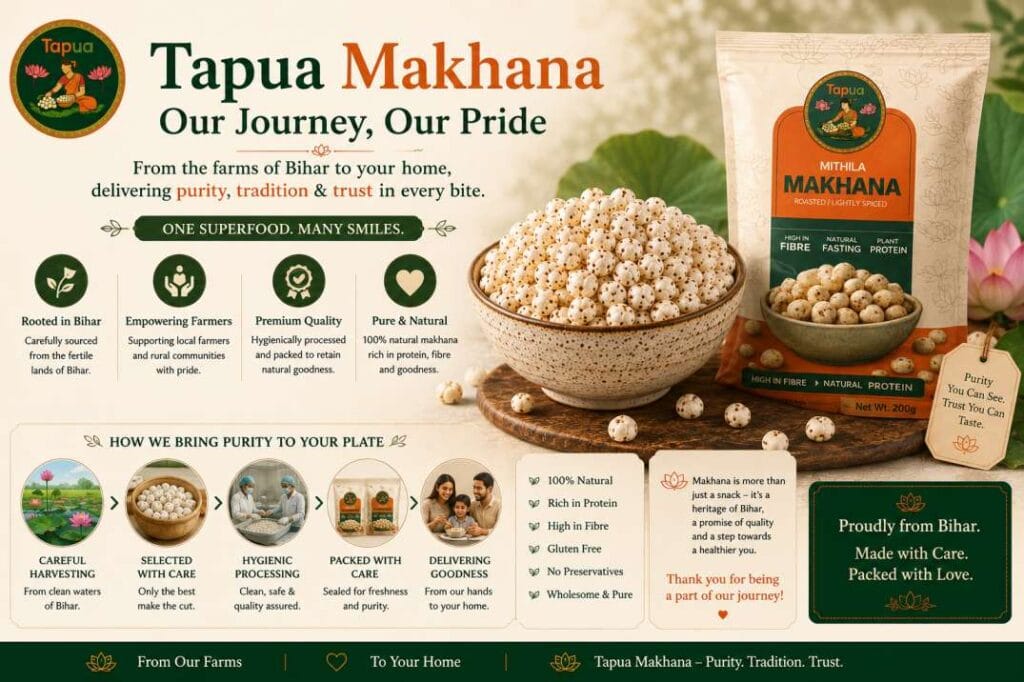
A pack of makhana that sells for under two hundred rupees in a Patna market can sit on a New York health-food shelf priced like an imported delicacy. That is not an accident of branding. It is what happens when a regional snack turns into a fast-moving export category: Indian makhana shipments grew close to four times over between 2020 and 2024, and the country that grows nearly all of the world’s supply is still catching up to the demand.
This piece looks at where that makhana is actually going, what a newly created government board is trying to fix about how it gets there, and why the people standing in Mithila’s ponds at harvest time are the ones who make any of it possible. Tapua’s own makhana comes out of those same ponds, so watching this market grow from the outside is a strange feeling when you already know exactly whose hands the growth runs through.
From a Regional Snack to an Export Category
Until fairly recently, makhana barely came up in conversations about Indian agricultural exports. Indian shipments stood at around 6,700 tonnes in 2020. By 2024, they had climbed to roughly 25,130 tonnes, a near-fourfold jump in four years, growing at close to 39% a year on average.
That growth tracks a broader shift in how the world eats. Low-calorie, high-protein snacking has gone from a niche health-food aisle concern to mainstream grocery shopping in the US, UK, and Gulf countries, and makhana happens to fit that brief almost exactly: roughly 350 calories and 9 to 10 grams of protein per 100 grams, with none of the allergens that rule out peanuts or tree nuts for a lot of buyers. The India makhana market, domestic and export combined, was valued at roughly ₹9.29 billion in 2025 and is projected to almost double by 2034.
Who Is Actually Buying Bihar’s Makhana
Three markets account for the overwhelming majority of what leaves India: the United States takes around 40% of total makhana exports, Canada about 20%, and the UAE roughly 17%, together adding up to more than three-quarters of everything shipped out. The US alone imports close to 2,000 tonnes a year.
The prices these markets pay vary more than you would expect for what is, on paper, the same basic product. US buyers pay around $19.5 per kilogram, Canadian buyers closer to $15.8, and UAE buyers nearer $13.3, a gap that mostly comes down to grading, packaging, and how the product gets positioned once it lands. A premium, large-grade pack marketed as a health snack commands more than a bulk shipment headed for repackaging.
Tapua’s own grading system is built around exactly this kind of size consistency, the same consistency export buyers pay a premium for once a batch crosses a border.
The Farmers Behind the Export Numbers
None of this growth shows up in a pond in Madhubani or Darbhanga as a number. It shows up as more people needed at harvest, longer hours in waist-deep water, and a narrower window to get the season’s crop sorted before the next one starts. Bihar still grows close to 90% of the world’s makhana, almost all of it tended by Mallah families whose work in these wetlands goes back generations, long before “export market” was a phrase anyone used about this seed.
Harvesting makhana is still done by hand. Workers wade into the ponds and feel along the muddy bottom for ripe seed pods that cannot simply be seen from the surface, then dry, roast, and pop them in small batches using methods that have not changed much even as the volumes around them have exploded. Tapua sources from these same Mallah farming communities, which is the part of this growth story that doesn’t show up in an export chart: behind every tonne shipped out is a family that spent a season standing in a pond to make it possible.
What the National Makhana Board Is Trying to Fix
The Indian government opened the National Makhana Board in Purnea, Bihar, in September 2025, backed by a ₹476 crore central scheme running through 2030-31. Its stated job is to clean up the weak points between farmer and export crate: better seed quality through agricultural universities in Sabour and Samastipur, more consistent processing standards, and direct support for farmers trying to reach export markets instead of selling everything to a middleman at the pond’s edge.
Whether a ₹476 crore scheme meaningfully changes life for a Mallah farming family remains to be seen this early. What it does confirm is that makhana has moved from a regional curiosity to something the government considers worth a dedicated board, which is a different kind of recognition than a sales chart.
What This Growth Means If You Buy Makhana at Home
For anyone buying makhana in India rather than importing it, the export boom shows up indirectly: rising domestic prices, as international buyers willing to pay export rates compete for the same harvest as local buyers, and growing pressure on quality grading as more of the crop gets sorted for shipment rather than the local market.
It also means the grading and traceability that used to matter mostly to local buyers who knew their supplier now matter globally too. A pack that can be traced back to a specific pond and farming family is no longer just a nice story for a label; it is becoming the kind of detail that separates a commodity export from a premium one.
Questions People Ask
How much makhana does India export every year?
Indian makhana exports reached roughly 25,130 tonnes in 2024, up from about 6,700 tonnes in 2020, a near-fourfold increase over four years.
Which countries buy the most Indian makhana?
The United States, Canada, and the UAE together account for more than three-quarters of India’s makhana exports, with the US alone responsible for around 40%.
Why does makhana cost more abroad than in India?
Export-grade makhana is typically larger and more uniformly sorted, and it carries the added cost of freight, since makhana is light and bulky and a shipping container holds far less of it by weight than denser cargo. Repackaging, branding, and retail markups in the destination country add further to the price.
What is the National Makhana Board?
It is a central government body set up in September 2025, based in Purnea, Bihar, with a ₹476 crore budget through 2030-31 to improve makhana seed quality, processing, and export support.
Does Bihar still grow most of the world’s makhana?
Yes. Bihar accounts for close to 90% of India’s makhana production, and India itself supplies the overwhelming majority of the world’s makhana.
The export numbers will likely keep climbing for a while yet, mostly because global demand for a high-protein, low-allergen snack is not slowing down. What is worth remembering, the next time a pack shows up on a shelf priced like an import, is that the rise happened pond by pond, in a part of Bihar most of the people buying it have never heard of.