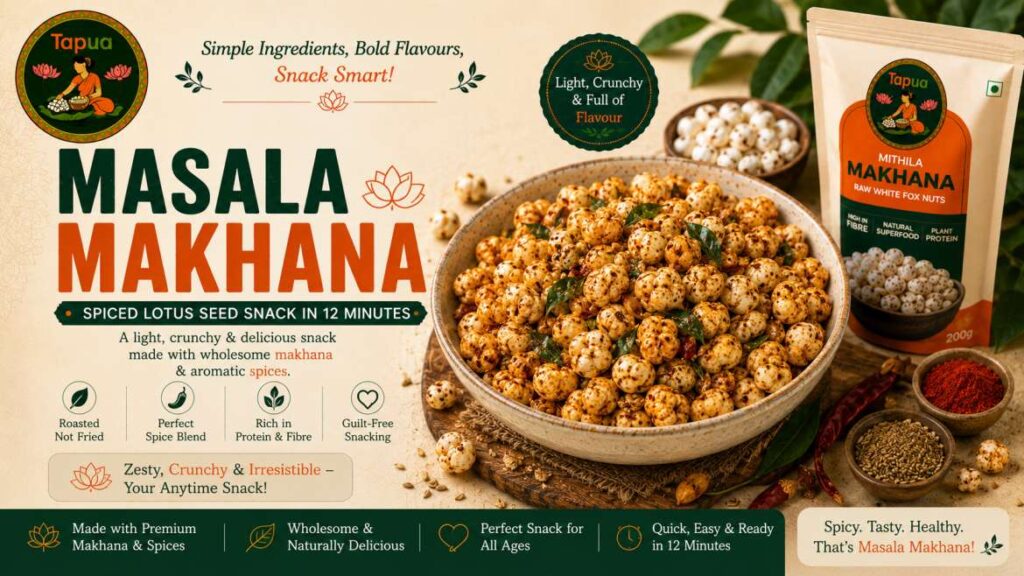
The spices go in after the heat is off. That’s the one thing most masala makhana recipes get wrong, and it’s also the simplest fix. Kashmiri red chilli burns in seconds over live heat — it turns bitter before it has a chance to flavour anything. Off the heat, with the residual warmth of the pan to help it stick to the ghee-coated makhana, it distributes evenly and holds.
The Mallah families who harvest makhana from the wetland ponds of Mithila have been eating roasted, spiced makhana — pulled straight from the pan, seasoned with whatever was nearby — for generations. The recipe doesn’t need improving. It needed the right sequence: roast first, flame off, season second.
What makhana does with masala
Makhana’s surface is porous and slightly starchy, which means dry spices need something to grip. A thin coat of ghee from the roasting stage provides exactly that. Chaat masala needs to go on last — after the other spices — to preserve its sour brightness. Cook it over live heat and the tang from the amchur disappears entirely.
Ingredients
- 1 tsp ghee [or neutral oil for vegan]
- 2 cups phool makhana (fox nuts / lotus seeds)
- ½ tsp Kashmiri red chilli powder [or paprika]
- ¼ tsp black pepper powder
- ¼ tsp cumin powder
- ½ tsp chaat masala
- ¼ tsp salt [or sendha namak for vrat]
Cook’s tip: Measure and mix all the spices before the makhana goes in the pan. Once roasted and off the heat, you have about 20 seconds of useful residual warmth — pre-mixing means you coat everything in one action without losing that window
Step-by-Step
- Heat the ghee in a large kadai over low flame. Add the makhana and stir immediately to coat each piece.
- Roast on low for 7–10 minutes, stirring every 45 seconds. Watch for the colour to shift from white to pale cream and each piece to feel lighter in the pan — the moisture has gone.
- Turn off the flame. Immediately tip in the pre-mixed spices and salt. Stir quickly and thoroughly for 30–40 seconds while the pan is still warm.
- Tip onto a plate and spread in a single layer. Cool completely before tasting — the crunch finishes developing as they cool.
How to serve
Best eaten warm, straight from the bowl. It pairs well with masala chai or black coffee where the bitterness cuts the spice. For entertaining, serve in a wide shallow bowl with lime wedges on the side. For desk snacking, pack in a sealed container — it holds crunch for the full working day.
Storing
Airtight container at room temperature, up to 7 days. Glass keeps moisture out better than plastic. If the makhana softens, a 2-minute dry roast on low heat revives the crunch. The sendha namak version keeps just as well and is fully vrat-compliant.
People always ask…
Skipping the ghee
Coconut oil and olive oil both work. Coconut adds a faint sweetness that pairs well with Kashmiri chilli. The crunch is identical — the flavour shifts slightly but pleasantly.
Why the spices won’t coat evenly
The makhana probably wasn’t warm enough when the spices went in, or the pan had cooled too much. The spices need freshly roasted makhana warmth to adhere. Move quickly after turning off the flame.
Making it for vrat
Use sendha namak instead of regular salt. Kashmiri chilli, cumin, and pepper are all vrat-friendly. Skip chaat masala if your fasting rules exclude amchur, or replace with a squeeze of fresh lime after cooling.
How long it keeps
Up to 7 days in an airtight container. Quality is best in the first 3 days when the spice flavour is freshest.
Adjusting the heat level
Kashmiri red chilli is mild and primarily adds colour. For more heat, add a pinch of regular red chilli powder alongside it. For no heat at all, paprika gives the colour without any spice.