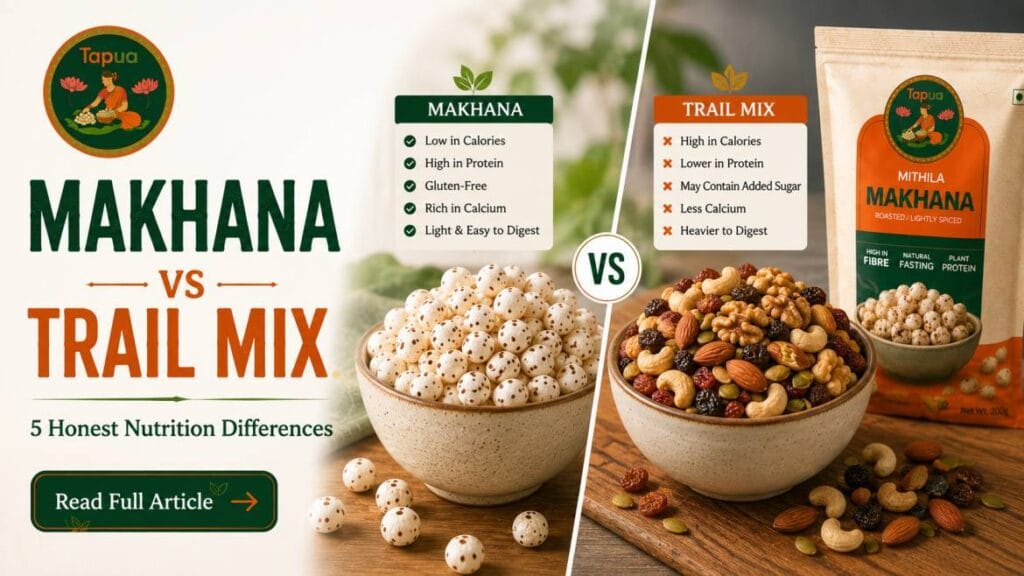
Trail mix has the better reputation. It shows up in gym bags, airport kiosks, and “healthy snack” roundups far more often than roasted makhana does, mostly because a jar of nuts, seeds, and dried fruit looks like it was assembled by someone who reads nutrition labels for fun. The reputation and the actual numbers don’t always agree, and a straight makhana vs trail mix comparison, gram for gram, turns up a few things most of those roundups skip.
This is a direct comparison using a standard bag of mixed trail mix (nuts, seeds, dried fruit, and chocolate chips) against plain roasted Tapua makhana, both measured per 100g. By the end you’ll know which one actually fits your day, whether that’s managing weight, sodium, sugar, or just getting through a 4pm slump without a vending machine run.
The Numbers, Gram for Gram
Plain roasted makhana comes in at roughly 347 kcal, 9.7g protein, 0.1g fat, and 14.5g fibre per 100g. A standard trail mix with chocolate chips, salted nuts, and seeds runs closer to 484 kcal, 14.17g protein, 31.86g fat, 44.92g carbohydrate, and around 23.9g sugar per 100g, according to USDA nutrient data. Trail mix wins on protein and raw energy density. Makhana wins on almost everything else, especially fat and sugar.
Where Trail Mix Genuinely Wins
Calorie density is an advantage, not a flaw, if you’re hiking, cycling long distances, or need to refuel quickly between training sessions. The nuts in a good trail mix bring healthy unsaturated fats and a meaningful protein bump per handful, which matters when you need a lot of energy in a small volume of food. For pure endurance fuel, trail mix earns its place in a backpack.
Where Makhana Genuinely Wins
For everyday snacking rather than endurance fuel, the equation flips. Makhana has a fraction of the fat, virtually none of the added sugar, and, when roasted plain, far less sodium than most packaged trail mixes carry. It’s also more filling per calorie. The puffed, airy texture means a 100g portion takes up a lot more space in a bowl than 100g of dense nuts and dried fruit, so you’re full before you’ve eaten anywhere near the calorie count of an equivalent trail mix serving.
The Sugar and Sodium Problem Most Trail Mixes Have
Read the ingredient label on a commercial trail mix and chocolate chips, candy-coated pieces, or sweetened dried fruit usually show up near the top. That’s where a meaningful share of the 23-24g of sugar per 100g comes from, and it’s easy to eat past a single serving without noticing. Salted nut blends carry the equivalent problem on the sodium side. Plain roasted makhana, unless you’ve seasoned it heavily yourself, carries close to none of either.
Which One Actually Fits Your Day
If you’re out on a long hike, cycling, or need dense calories fast, trail mix is doing a job makhana isn’t built for. If you’re snacking at a desk, managing weight, watching sugar or sodium, or just want something crunchy that doesn’t undo the rest of your day’s eating, plain roasted makhana is the better fit more often than not. Worth noting too, makhana’s modest, unprocessed ingredient list traces back to a single source: a specific pond and a specific farming family, in Tapua’s case, the Mallah communities of Mithila who’ve harvested it for generations. Trail mix, by contrast, is usually a blend from several different suppliers you’ll never be able to trace.
What People Usually Ask
Is trail mix healthier than makhana for weight loss?
Generally not. Trail mix is far more calorie-dense and often carries added sugar from chocolate or dried fruit, which makes portion control harder when you’re trying to lose weight.
Why does trail mix have more calories than makhana?
Nuts and seeds are naturally fat-dense, and most commercial mixes add chocolate or sweetened dried fruit on top of that, while makhana is mostly air and starch with almost no fat.
Can diabetics eat trail mix instead of makhana?
It depends on the mix. A no-sugar-added nut and seed blend is reasonable in small portions, but chocolate-chip or candied trail mix can spike blood sugar in a way plain makhana won’t.
Is homemade trail mix better than store-bought?
Usually, since you control the sugar and salt. A homemade mix of plain nuts, seeds, and unsweetened dried fruit narrows the gap with makhana considerably, though the fat and calorie density stays naturally higher.
Which snack is better for a long hike or workout?
Trail mix, for sheer calorie density in a small volume. Makhana is better suited to everyday snacking than to refuelling mid-hike, where you need more energy per bite than its airy texture provides.
Neither snack is wrong to reach for, they’re just built for different moments. Tapua makhana happens to be one of the few snacks left where you can trace the bag back to the exact pond it grew in, which doesn’t change a single number in this comparison but is a nice thing to know all the same.
Leave a Reply