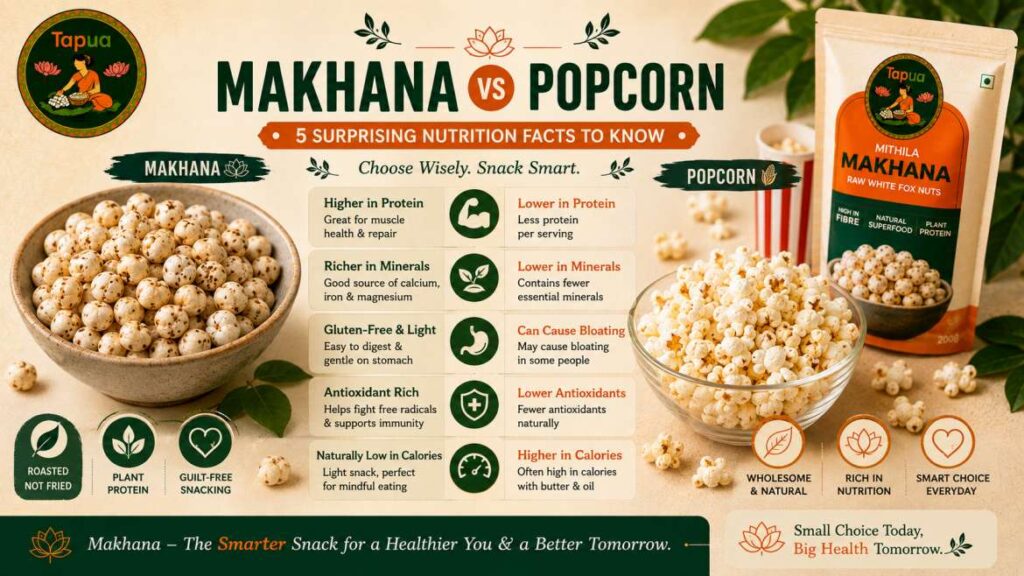
Someone always brings this up when the snack bowl comes out: popcorn is “just corn and air,” so surely it beats makhana on health grounds. It’s a reasonable guess. It’s also wrong more often than it’s right, and the reason has less to do with corn or lotus seeds than with what each label is actually measuring.
This is a straight comparison of makhana vs popcorn using the same measure for both: dry weight, no toppings. The numbers come from USDA and Indian food composition data, not from a brand trying to sell you one or the other. A bag of Tapua makhana sat next to a bowl of plain popcorn while this was put together, which is the only way to actually settle an argument like this.
By the end, you’ll know where each snack genuinely wins, where the comparison breaks down once butter and salt enter the picture, and which one makes more sense for a fasting day, a diabetic diet, or a 4pm desk craving.
Why Popcorn Has a Head Start in People’s Minds
Popcorn gets called a whole grain on nutrition labels, and that’s true. It also gets measured in cups on most packaging, and a cup of air-popped popcorn weighs only about 8 grams. That tiny serving size makes the calorie count look almost free: roughly 31 calories a cup.
Makhana is usually sold and eaten by weight, not by cup, and a generous snack-sized handful runs 25 to 30 grams. Compare a small cup of one against a small handful of the other and you’re not really comparing equal amounts of food, you’re comparing two very differently sized portions and calling it a fair fight.
The only honest way around this is to compare both on the same scale: per 100 grams, dry, unsalted, no oil. That’s what the numbers below do.
The Numbers, Gram for Gram
Here’s how plain roasted makhana stacks up against plain air-popped popcorn, both measured per 100 grams, sourced from Indian food composition data and the USDA FoodData Central database.
| Nutrient (per 100g) | Makhana, roasted | Popcorn, air-popped |
|---|---|---|
| Calories | 347 kcal | 387 kcal |
| Protein | 9.7 g | 12.9 g |
| Fat | 0.1 g | 4.5 g |
| Fibre | 14.5 g | 14.5 g |
| Calcium | 60 mg | negligible |
| Phosphorus | 367 mg | 358 mg |
A few things jump out. Fibre is a near-exact tie. Phosphorus is close enough not to matter for most people. Plain air-popped popcorn actually has more protein per 100 grams than makhana, and it isn’t far behind on calories either, despite the reputation makhana has for being the lighter option.
What the Fibre Tie Actually Means
Both snacks land at almost exactly 14.5 grams of fibre per 100 grams, which surprises people who assume makhana wins everything. It’s worth asking what kind of fullness that fibre buys you, not just the number on the label.
Popcorn’s fibre sits mostly in the hull, the part that gets stuck in your teeth, and it moves through digestion fairly quickly once it’s chewed. Makhana’s fibre is bound up with its starch, which is part of why a roasted batch keeps you satisfied for longer than the same weight of popcorn, even with matching fibre totals. The number is identical; the experience of eating it usually isn’t.
There’s also a practical fullness factor that has nothing to do with fibre: makhana’s hollow, airy pieces take up real volume in the stomach for very little weight. A 25-gram handful looks and feels like more food than 25 grams of popcorn, which has its own way of helping you eat less without trying to.
Cost and Practicality for Everyday Snacking
Per-rupee value tends to favour makhana for one practical reason: it travels and stores well in its dry, roasted form, often staying crisp for a week or more in an airtight container, while fresh popcorn turns chewy and stale within a day if it isn’t sealed properly.
For lunchboxes and desk drawers specifically, that storage gap matters more than the nutrition panel. A batch of roasted makhana made on Sunday is still good by Thursday. Popcorn popped on Sunday rarely survives that long without going soft, which pushes most people toward packaged, preservative-laden versions instead of the fresher, plainer option.
Where Popcorn Genuinely Wins
Credit where it’s due: unsalted, air-popped popcorn is a legitimately good whole-grain snack. It has more protein per 100 grams than makhana, it’s naturally low in sodium before anyone touches it, and it brings a different set of antioxidants (mostly polyphenols concentrated in the hull) that makhana doesn’t really offer.
If your only goal is grams of protein per calorie and you’re eating it plain, popcorn earns the comparison fairly. The catch, and it’s a big one, is that very few people eat it that way.
Where the Comparison Falls Apart in Real Life
Almost nobody eats 100 grams of plain air-popped popcorn. Movie theatre popcorn, drenched in butter or a butter-flavoured oil, runs closer to 550 calories, 35 grams of fat, and as much as 980 milligrams of sodium per 100 grams. That’s not a snack anymore, it’s closer to a meal’s worth of fat in one sitting.
Makhana follows the opposite pattern. Most home recipes use a teaspoon of ghee for a full batch, not a tablespoon of oil per handful, and a lot of people eat it dry-roasted with nothing added at all. The starting point for makhana tends to stay close to that 347-calorie baseline. The starting point for popcorn, in practice, usually doesn’t.
So the fairer question isn’t “which food wins on paper,” it’s “which one is harder to ruin once you actually prepare it.” On that measure, makhana has the advantage, simply because its usual seasoning additions are lighter.
Why Texture Changes How Much Oil You Actually Need
There’s a practical reason makhana doesn’t need much fat to taste good, and it comes down to how evenly a batch roasts. Tapua sorts its makhana by hand rather than running it through a machine, which keeps the Suta grade pieces close to the same size. Uniform pieces roast at the same rate, so the whole batch crisps together instead of half the pieces staying chewy.
A batch with mixed sizes needs more oil and more salt to make the soft, under-roasted pieces palatable. A batch that roasts evenly doesn’t have that problem, which is a quieter reason than the protein chart for why one snack tends to stay lighter than the other once it actually reaches a bowl.
How to Roast Either One Without Ruining It
Both snacks can go from genuinely good to inedible in under a minute on the stove, and the failure pattern is almost identical: too much heat for too long, with fat added before the pan is properly hot. For makhana, the safer order is to dry-roast on medium heat first, stirring constantly, until the pieces start sounding hollow rather than damp when the spoon hits them. Only then does a teaspoon of ghee go in, swirled through quickly so it coats rather than pools at the bottom of the pan.
For popcorn, the equivalent mistake is letting kernels sit in oil that hasn’t come up to temperature, which produces chewy, half-popped kernels instead of light, fully expanded ones. A wide, heavy-bottomed pan with a lid, three or four test kernels dropped in first as a heat check, and constant shaking once popping actually starts will outperform most stovetop instructions written for a smaller batch than what most households actually cook.
Neither snack genuinely needs much fat to taste good once the roasting or popping technique is right. Most of the oil or ghee people add is solving a flavour problem, under-seasoned popcorn or under-roasted makhana, rather than a structural one. Get the heat and timing right first, and the seasoning that follows can stay light without the result tasting bland.
What This Means If You’re Watching Sugar or Sodium
For anyone managing blood sugar, the relevant difference isn’t really the small calorie gap, it’s that makhana digests more slowly thanks to its starch structure, a point covered in more depth in our . Popcorn isn’t bad for blood sugar either, but packaged and flavoured versions often carry more added sugar and sodium than people expect.
For fasting days, makhana has the clearer edge: it’s a recognised vrat food across Navratri, Ekadashi, and other fasts, detailed in our , while popcorn isn’t traditionally part of that list at all.
Which One Actually Belongs in Your Desk Drawer
If the question is genuinely practical, what should sit in a drawer or a kitchen shelf for a few weeks, makhana wins on logistics alone. A sealed jar of roasted makhana holds its crunch far longer than popped corn, which softens noticeably once any humidity reaches it, and a half-eaten bag of popcorn left open overnight is rarely worth finishing by the next afternoon. That storage gap shows up in practice more than any number on a nutrition label.
Popcorn still makes complete sense as a movie-night or commute snack that gets finished in one sitting, where freshness for a week doesn’t matter at all. Makhana makes more sense as the snack that’s still good on a Friday when it was roasted on a Monday. Choosing between them honestly comes down to how long the food actually needs to survive before someone eats it.
Questions People Ask
Is makhana healthier than popcorn for weight loss?
Plain, dry-roasted versions of both are close on calories. Makhana tends to win in practice because people add less oil and salt to it, not because of some inherent calorie advantage on the label.
Does popcorn really have more protein than makhana?
Per 100 grams, plain air-popped popcorn does edge out makhana on protein, 12.9 grams against 9.7 grams. It’s a smaller gap than most comparison articles suggest, and it disappears once butter or oil enters the picture.
Can diabetics eat popcorn instead of makhana?
Plain air-popped popcorn in moderation is generally fine, but makhana’s slower-digesting starch gives it a slight edge for blood sugar management, and it’s a far more forgiving fasting-day option.
Which one is better for a fasting day?
Makhana, without much competition. It’s an established part of Navratri and Ekadashi fasting traditions in a way popcorn simply isn’t.
Is movie theatre popcorn ever a fair comparison to makhana?
No. Buttered theatre popcorn can carry 550 calories and 35 grams of fat per 100 grams, more than triple the fat content of an average roasted makhana batch. Compare like with like, or the numbers stop meaning anything.
Which snack is better for someone managing weight, not just calories?
Makhana tends to work better in practice, not because of a hidden metabolic advantage on the label, but because a small handful feels like a fuller portion and most people stop eating it sooner than they’d stop eating an equivalent bowl of popcorn, especially once any seasoning is added to either one.
Does the roasting method change the nutrition numbers much?
Dry roasting changes almost nothing nutritionally for either snack. Adding a tablespoon of oil or ghee per serving adds roughly 120 calories and 14 grams of fat regardless of which base you start with, which matters more to the final number on your plate than anything inherent to corn or lotus seeds.
Is one of these more filling per calorie than the other?
Gram for gram they’re close, but makhana’s hollow, airy structure means a normal serving takes up more visible space in a bowl for the same number of calories, which is part of why it tends to feel more filling than the calorie count alone would suggest.
Next time this comes up over snacks, you’ll have the actual gram-for-gram numbers instead of a guess, and a better question to ask: not which snack wins on a label, but what’s actually going into the bowl in front of you. A handful of Tapua makhana, roasted plain or with the lightest dusting of spice, tends to answer that question on its own.
Leave a Reply