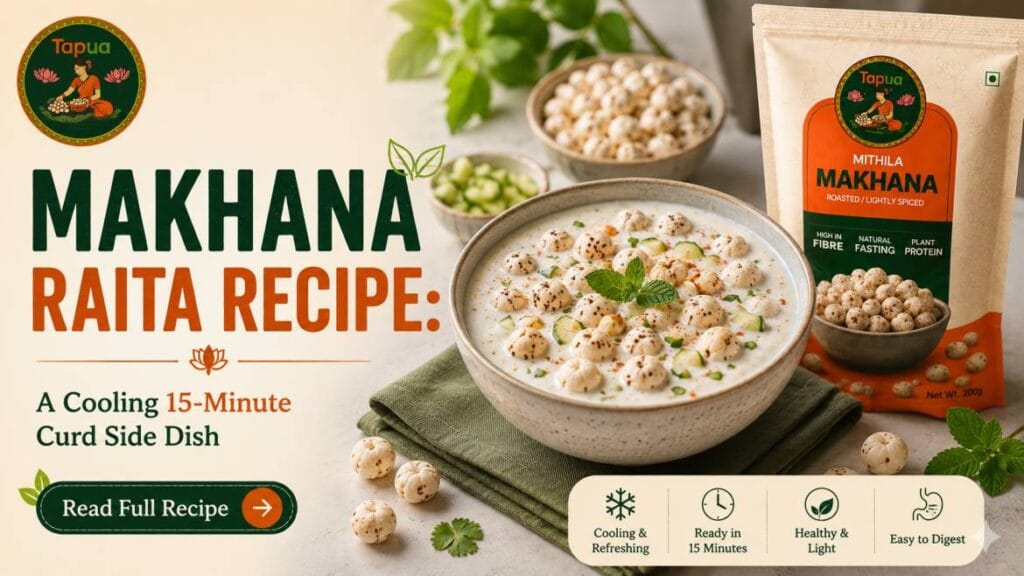
Curd alone gets boring by the third hot week of summer, and most people’s instinct is to dress it up with cucumber or boondi and call it done. Crushed roasted makhana does something neither of those quite manages: it stays crisp at the edges for a few minutes even inside the curd, giving you a raita with actual texture instead of a uniform spoonful of cold and sour. This one takes about fifteen minutes, needs no cooking beyond a quick dry roast, and works as a side for almost anything heavier sitting next to it on the plate.
Why Makhana Holds Up in This Raita
Makhana’s whole appeal here is contrast. Curd is smooth and a little sour; crushed makhana brings a dry, faintly nutty crunch that takes a minute or two to soften, so the first few bites and the last few bites taste noticeably different. If you’re using Tapua’s Suta grade, the larger, more uniform pops crush into bigger, crisper shards rather than fine crumbs, which holds its texture a little longer once mixed in. It is a small thing, but it is the difference between a raita that stays interesting through the bowl and one that turns into flavoured curd by the last spoonful.
What You’ll Need
- 1 cup fresh chilled curd (yogurt), whisked smooth
- 2/3 cup Tapua roasted phool makhana
- 1/4 tsp red chilli powder
- 1/2 tsp roasted cumin powder, ground
- 1 pinch garam masala
- 2 tbsp coriander leaves, chopped
- Black salt, or regular salt, to taste
- 1 to 2 tbsp water (optional, to thin if needed)
Garnish / to serve:
- A few extra coriander leaves
- A light dusting of roasted cumin powder
Instructions
- Heat a small, dry pan over low heat and add the makhana. Dry-roast for 4 to 5 minutes, stirring often, until it sounds hollow when you tap a piece against the pan and turns a shade darker.
- Let the roasted makhana cool fully on a plate. It needs to be completely cool before crushing, or it turns chewy instead of staying crisp.
- Crush the cooled makhana coarsely, either with a rolling pin inside a sealed bag or with a few short pulses in a dry grinder. You want broken pieces, not a fine powder.
- Whisk the curd in a mixing bowl until smooth, then stir in the red chilli powder, cumin powder, garam masala, and black salt.
- Fold the crushed makhana into the spiced curd just before serving, along with the coriander leaves.
- Taste and adjust the salt, then serve right away while the makhana still has some crunch left in it.
Cook’s tip: Mix the makhana into the curd only at the table, not ten minutes before. It softens fast once it’s sitting in liquid, and a raita made even fifteen minutes ahead loses most of the crunch that makes this version worth making in the first place.
Serving and Storing
Serve it straight away alongside a pulao, biryani, or any rice dish that benefits from something cold and a little sharp next to it. It also works as a light side with parathas, or on its own with a few extra coriander leaves on top if you want something cooling on a hot afternoon.
The curd base keeps for a day in the fridge, but hold off mixing in the makhana until just before you plan to eat it. Once combined, the makhana softens within the hour, and chilling the finished raita too long makes it thicken considerably, so loosen it with a spoonful of water if that happens.
Made for This Season
Raita in general is a hot-weather habit in North Indian kitchens, and a makhana version fits the same logic: light, barely cooked, and cooling enough to sit next to spicier food without competing for attention. It also happens to work during phalahar fasting days like Ekadashi or Navratri, since makhana and curd are both within bounds for most fasting diets, which is worth knowing if you’re already looking for fasting-friendly options that don’t feel like a compromise.
A Few Things People Ask
Can I make makhana raita ahead of time?
The spiced curd base can be made a few hours ahead and chilled, but add the crushed makhana only right before serving, or it loses its crunch.
Is makhana raita good for fasting (vrat)?
Generally yes, since both makhana and curd are accepted in most phalahar fasting diets, though it’s worth checking your own household’s specific fasting rules since they vary.
Why did my raita turn watery or too thick?
Watery usually means the curd was thin to begin with, so whisk it well before adding spices. Too thick usually means it sat in the fridge too long after mixing; a spoonful of water loosens it right back up.
Can I temper this raita instead of leaving it plain?
Yes. A small tempering of cumin seeds and a pinch of asafoetida in hot ghee, cooled slightly and stirred in, adds a savoury note if you want it less plain than the basic version.
Is makhana raita a healthy choice?
It’s a reasonably light, protein-leaning side dish, curd and a modest amount of roasted seed, with nothing fried in it, which makes it an easy fit for most everyday meals.
This is a small bowl, not a centrepiece, but it earns its place on the table by being the one thing that’s cool when everything else on the plate isn’t. Tapua’s QR code happens to trace this batch back to a specific pond and the family that harvested it, though the raita tastes the same either way.
Leave a Reply