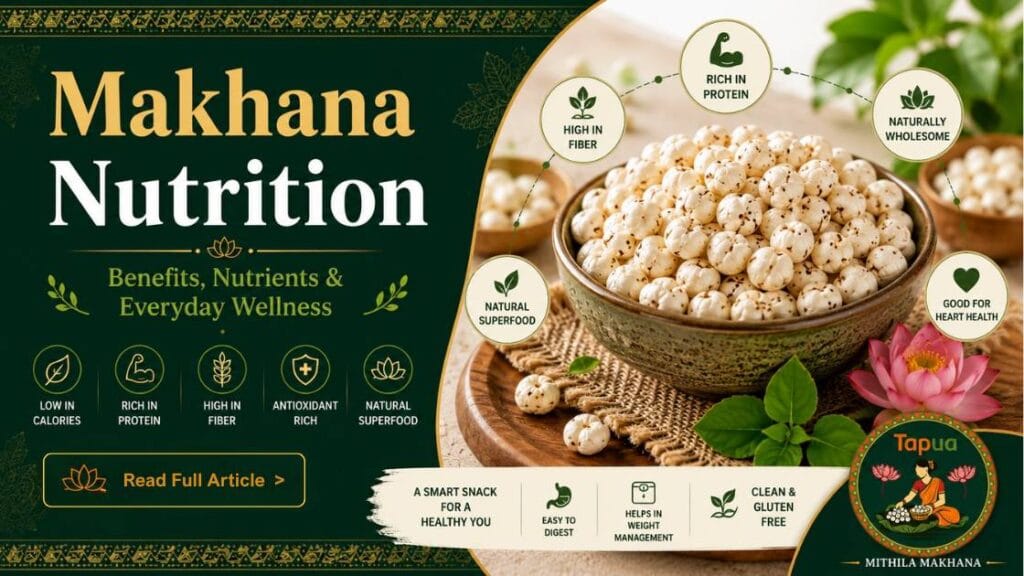
If you judge foods by their ingredient lists, makhana wins before the conversation even starts: one ingredient. Just makhana. No oil. No salt. No preservatives. Nothing.
But the makhana nutrition story goes well beyond what it doesn’t have. What makhana does contain — its complete protein profile, its extraordinary mineral density, its fibre content, its low glycemic index — puts it in a category that few snack foods can claim. This guide breaks down every number, explains what each nutrient does, and tells you honestly how makhana fits into a real daily diet.
Table of Contents
- Makhana Nutrition Facts Per 100g
- Macronutrient Breakdown: Calories, Protein, Carbs & Fat
- The Complete Protein Story
- Fibre — The Underappreciated Number
- Mineral Profile: Where Makhana Really Shines
- Makhana Glycemic Index and Glycemic Load
- Makhana Nutrition vs. Other Popular Snacks
- How Much to Eat for Optimal Nutrition
- FAQs
Makhana Nutrition Facts Per 100g
All values are for plain, traditionally processed makhana (no added oil, salt, or flavourings):
- Calories: 347 kcal
- Protein: 9.7g
- Total Carbohydrates: 76.9g
- Dietary Fibre: 14.5g
- Sugars: ~0g (negligible)
- Total Fat: 0.1g
- Saturated Fat: Trace
- Sodium: ~1mg (essentially sodium-free in natural form)
- Calcium: 60mg
- Magnesium: 210mg
- Phosphorus: 200mg
- Iron: 1.4mg
- Zinc: ~1.1mg
- Potassium: ~500mg
- Glycemic Index: 38–42 (low)
Sources: Ayur Times nutritional analysis | AceBlend Makhana Nutrition Guide | IJNP Formulation and Proximate Analysis study (2024).
Macronutrient Breakdown: Calories, Protein, Carbs & Fat
Calories
At 347 kcal per 100g, makhana is moderate in caloric density — significantly lower than nuts (570–630 kcal/100g), comparable to whole grains, and far lower than fried snacks (500+ kcal/100g) on a per-gram basis. A practical 30g snack serving is approximately 104 calories.
Protein — Complete and Competitive
Makhana’s protein content of 9.7g per 100g is comparable to cooked chicken breast (31g/100g but with 70% water weight) and higher than most snack foods, legumes by serving, and certainly higher than any grain snack.
But protein quantity alone doesn’t tell the full story. What makes makhana nutrition exceptional is the quality of the protein: it contains all nine essential amino acids, including methionine and lysine — two amino acids consistently deficient in plant-based diets (particularly in grains and legumes).
This makes makhana a “complete protein” — a classification usually reserved for animal foods and soy. Among plant snacks, this is extremely rare.
Carbohydrates — The Right Kind
The 76.9g carbohydrate figure looks high at first glance. But context matters. Of those carbohydrates:
- 14.5g is dietary fibre — which is not digested and does not raise blood glucose
- The remaining ~62g is complex starch, digested slowly due to the low GI (38–42)
- Sugars are negligible (~0g) — there is no intrinsic sweetness in plain makhana
So while the total carb number is high, the effective glycemic impact is low — a combination of high fibre and low GI starch that produces slow, stable blood sugar responses.
Fat — Essentially Zero
At 0.1g total fat per 100g, makhana is among the lowest-fat foods that exist. This is nutritionally meaningful: the crunch of makhana is achieved without any fat content, through the mechanical expansion of the kernel during the hand-popping process. No seed oil, no butter, no frying.
The Complete Protein Story
Most plants are “incomplete proteins” — they’re missing one or more essential amino acids. This forces vegetarians and vegans to combine foods carefully (rice + dal, for example) to get complete protein.
Makhana is one of the rare plant exceptions. Its amino acid profile includes:
- Methionine: essential for liver health, detoxification, and cartilage synthesis; commonly low in plant proteins
- Lysine: essential for protein synthesis, calcium absorption, and immune function; typically deficient in grains
- Tryptophan: precursor to serotonin and melatonin; supports mood and sleep
- Leucine, Isoleucine, Valine: the branched-chain amino acids essential for muscle protein synthesis
This makes makhana genuinely valuable for vegetarians, vegans, athletes, and anyone seeking diverse plant protein sources. A 30g serving provides ~2.9g complete protein — modest but meaningful as part of a varied diet.
Fibre — The Most Underappreciated Number in Makhana Nutrition
The 14.5g dietary fibre per 100g is the makhana nutrition figure that deserves more attention than it gets. Here’s why:
- Average Indian dietary fibre intake is approximately 15–20g/day — well below the recommended 25–35g
- A 100g serving of makhana would single-handedly meet 50–60% of daily fibre needs
- A practical 30g snack serving provides 4.4g fibre — about 15% of daily requirements in a single snack
The type of fibre in makhana includes resistant starch — a form that functions as prebiotic fibre, feeding beneficial gut bacteria (Lactobacillus, Bifidobacterium) and improving the gut microbiome composition. This has downstream effects on immune function, inflammation, mental health, and metabolic health that go well beyond simple bowel regularity.
Mineral Profile: Where Makhana Nutrition Really Shines
Magnesium — The Star Mineral
At 210mg per 100g, makhana is one of the most magnesium-dense foods available — comparable to pumpkin seeds (156mg), spinach (79mg, cooked), and dark chocolate (228mg). A 30g serving provides ~63mg, roughly 15% of daily adult requirements.
Magnesium is involved in over 300 enzymatic reactions in the body. Deficiency is common in India (estimated at 60–70% of the population) and is associated with muscle cramps, anxiety, poor sleep, insulin resistance, high blood pressure, and fatigue. Makhana is one of the most practical and palatable ways to address this gap.
Calcium
At 60mg per 100g, makhana provides a meaningful non-dairy calcium source. For the lactose-intolerant, vegans, or those avoiding dairy, makhana contributes to calcium intake alongside leafy greens, sesame seeds, and fortified foods.
Phosphorus
At 200mg per 100g, makhana is an excellent phosphorus source. Phosphorus works alongside calcium for bone mineralisation and is involved in energy production (ATP synthesis) and cell membrane integrity.
Iron
1.4mg of iron per 100g is a modest but real contribution — about 8% of daily requirements for adult men and 5% for adult women (who need more). Combined with vitamin C-rich foods (lemon juice on makhana significantly enhances non-haem iron absorption), makhana can meaningfully contribute to daily iron intake.
Potassium
At ~500mg per 100g, makhana is a good potassium source — important for blood pressure regulation, muscle function, and cardiovascular health. The high potassium + near-zero sodium combination makes makhana one of the most heart-friendly snacks available.
Makhana Glycemic Index and Glycemic Load
The glycemic index (GI) of makhana is 38–42 — classified as low (below 55). This number reflects how quickly makhana’s carbohydrates enter the bloodstream as glucose relative to pure glucose.
But glycemic load (GL) — which factors in both GI and the actual amount of carbohydrate in a realistic serving — is more practically useful:
- 30g serving of makhana → ~23g carbs → glycemic load = approximately 8–10 (low-moderate)
- 50g serving → ~38g carbs → glycemic load = approximately 14–16 (moderate)
A glycemic load under 10 is considered low; under 20, moderate. A 30g snack of makhana comfortably falls in the low range — appropriate for most people including diabetics managing blood sugar.
Makhana Nutrition vs. Other Popular Snacks (Per 30g Serving)
- Makhana: 104 kcal | 2.9g protein | 4.4g fibre | 0.03g fat | GI 38–42
- Almonds: 174 kcal | 6.3g protein | 1.9g fibre | 14.9g fat | GI 15
- Roasted Chana: 123 kcal | 7.5g protein | 3g fibre | 2g fat | GI ~28
- Oat crackers: 132 kcal | 3g protein | 1.4g fibre | 5g fat | GI ~57
- Potato chips: 160 kcal | 2g protein | 1.2g fibre | 10.4g fat | GI ~75
- Rice cakes: 120 kcal | 2.5g protein | 0.6g fibre | 0.8g fat | GI ~82
Makhana wins on fat content, fibre density, and glycemic index. Almonds beat it on protein and fat quality; roasted chana is a stronger protein option. But makhana is the only option in this list that wins on all three of: low fat, high fibre, AND low GI simultaneously.
How Much Makhana to Eat for Optimal Nutrition
As a daily snack: 20–30g (approximately one small fistful) — 68–104 calories, 2–3g protein, 3–4g fibre
As a meal component: 50–100g in kheer, curry, or halwa, where it contributes protein and minerals to a broader dish
Maximum advisable daily intake: ~100g. Beyond this, the high phosphorus content becomes relevant for people with kidney disease, and the fibre can cause digestive discomfort.
FAQs
Does makhana have more protein than quinoa?
Per 100g raw: makhana has 9.7g protein; quinoa has ~14g. However, makhana is typically eaten at 30g (2.9g protein), while quinoa is typically cooked at 200g+ serving (much lower protein per cooked gram due to water absorption). On a per-serving comparison, they’re broadly similar — but both qualify as complete proteins.
Is makhana high in carbohydrates?
Yes — 76.9g carbs per 100g. But with 14.5g of that being fibre and a GI of 38–42, the actual blood sugar impact is far lower than the total carb number suggests. Effective net carbs for a 30g serving are approximately 19g, with a glycemic load of ~8 (low).
Is makhana nutritious enough to eat as a meal replacement?
No. Makhana is an exceptional snack and a nutritious meal component, but it lacks sufficient fat, vitamin diversity, and caloric density to function as a standalone meal. Use it as part of a balanced diet — roasted as a snack, or incorporated into complete dishes like kheer, curry, or trail mix.
Makhana nutrition is one of those things that gets more impressive the more carefully you look at it. Complete protein, near-zero fat, high fibre, low glycemic index, exceptional magnesium content, essentially no sodium — it’s a profile that most designed health foods spend years trying to achieve. Makhana achieves it by just being makhana.The one condition: it needs to be real makhana — traditionally processed, single-origin, GI-tagged, without additives. That’s exactly what Tapua sources and sells at tapuafoods.com/shop.