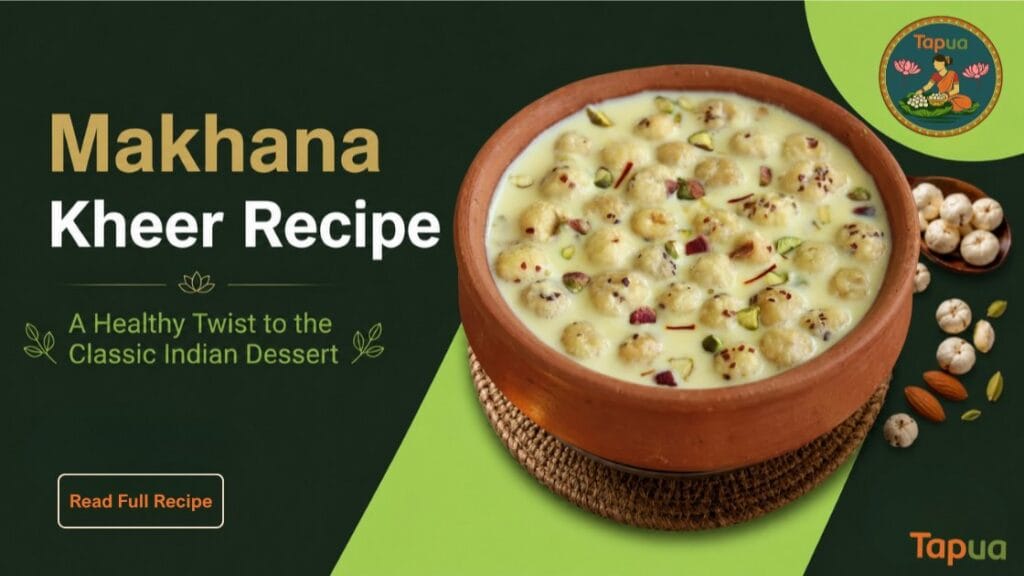
In Bihar winters, makhana kheer turns up the way chai turns up everywhere else — expected, comforting, not requiring explanation. My maa made it with whole milk from the neighbourhood dairy, and the pot would be on the stove long enough to fill the kitchen with the smell of ghee-roasted makhana and cardamom. It’s one of those dishes that has a season and a mood attached to it.
What makes this makhana kheer recipe work — and different from a plain rice kheer — is the technique of using two textures together. Most of the roasted makhana goes into a grinder: the powder thickens the milk and gives the kheer its body. The remaining third stays whole, softening slowly in the simmering milk until it’s tender but still recognisable. Creamy below, with something to bite into.
You’ll have it on the table in 35 minutes. It keeps well refrigerated, and on fasting days — Navratri, Ekadashi — it’s the dessert you can make without any substitutions.
Why makhana works in a kheer
Most kheer is thickened by reducing milk slowly over time, which can take an hour or more. Makhana speeds that up. Ground roasted makhana, when added to hot milk, absorbs the liquid and thickens it from within, the way fine semolina or ground rice would — but more gently, without the heaviness. The whole pieces soak up the milk and become something between a soft puff and a small dumpling: not mushy, not resistant.
Tapua Suta grade makhana, being larger and more uniform, holds its shape better through the simmering stage — you get whole pieces that are actually worth biting into rather than fragments that dissolve. That size distinction matters more in a kheer than it does in a dry snack.
The flavour of makhana itself is very mild and slightly nutty after roasting — it doesn’t compete with the saffron or cardamom, just carries them. That’s what makes this kheer so clean on the palate.
Ingredients
What you’ll need
- 1 cup makhana (fox nuts / phool makhana)
- 2 cups whole milk
- 3–4 green cardamom pods (husked and powdered)
- 10–12 cashews [or blanched, sliced almonds]
- 1 tbsp golden raisins
- 3.5–4 tbsp sugar [or jaggery / sugar-free sweetener to taste]
- 1 pinch saffron strands
- 2–3 tsp ghee
How to make makhana kheer recipe
- Heat the ghee in a wide pan on low heat. Add the makhana and cashews together and roast, stirring frequently, until the makhana is fully crunchy and the cashews turn golden — about 8–10 minutes. Don’t rush this; the crunch you build here is what gives the kheer its texture later.
- Remove everything to a plate. Set the cashews aside separately — they don’t go into the grinder.
- Reserve ⅓ cup of the roasted makhana and set aside. Add the remaining roasted makhana to a blender with the cardamom seeds and the saffron strands. Grind to a fine powder. The finer it is, the smoother and more body the kheer will have.
- Heat the milk in a heavy-bottomed saucepan on medium-low heat. Stir every minute or so to prevent scorching at the base. Let it come to a full boil.
- Add the sugar to the boiling milk and stir to dissolve. Then add the ground makhana powder and the reserved whole makhana. Stir thoroughly — the powder will try to clump if you don’t keep moving it.
- Reduce heat to low and simmer for 9–10 minutes, stirring at intervals. Scrape any milk solids that form on the sides of the pan back into the kheer — that’s concentrated flavour. The milk will thicken and the whole makhana pieces will soften noticeably.
- Add the roasted cashews and raisins. Stir and simmer for one more minute.
- Taste for sweetness and adjust. Remove from heat. Serve warm, at room temperature, or well-chilled. Remember: the kheer thickens further as it cools.
| Cook’s tip: Don’t skip the grinder step. Many recipes add makhana whole and simmer until soft, but grinding ⅔ of the batch gives you a thick, creamy base that sets this kheer apart from a watery milk pudding. The reserved whole pieces give texture inside that creaminess. |
How to serve makhana kheer
Serve warm in small bowls on a cold evening — that’s the original context and it’s still the best one. A few extra saffron strands or a sprinkle of crushed pistachios on top adds colour without complicating it. For a dinner party, serve chilled in individual glasses. For Navratri prasad, serve at room temperature in small quantities — a little goes further than you’d expect because the kheer is quite rich.
Storing leftovers
Refrigerate in a covered container for up to 2 days. The kheer thickens significantly in the fridge — add a small splash of warm milk and stir well before serving again. Don’t freeze; the milk proteins don’t hold up to freezing and thawing.
When this dish shows up
Makhana kheer is a Bihar and eastern UP winter dish in the same way that a good biryani is a celebration dish — it appears at weddings, at pooja, on Navratri evenings when the fast breaks, and on Ekadashi days when you want something that feels special but fits the rules. In Mithila, makhana has been part of ritual food — offered to deities, prepared during fasting — long before it became a health trend. Tapua makhana, sourced from the same wetland ponds of Mithila where these farming traditions are rooted, is the most connected version of this ingredient you can use.
December in Bihar means makhana kheer on the stove. If you’re anywhere else in the world, it means the same thing once you’ve made it once.
Questions people ask
Q: How to make makhana kheer?
Roast makhana in ghee, grind ⅔ of the batch with cardamom and saffron, reserve the rest whole. Bring milk to a boil, add sugar, add both the powder and whole makhana, simmer 9–10 minutes until thick and the whole pieces are tender. Add cashews and raisins at the end.
Q: Can I make makhana kheer for Navratri?
Yes — it’s one of the most traditional Navratri desserts. All the ingredients are vrat-friendly as long as you use regular sugar or rock sugar, and ghee rather than oil. No modifications needed for most Hindu fasting guidelines.
Q: Can makhana kheer be made without sugar?
You can substitute jaggery powder (adds a slight caramel note) or skip sugar entirely and sweeten with dates blended into the milk. The kheer will be less bright white but will taste good. Condensed milk is another option if you’re not fasting.
Q: Why is my makhana kheer too thick?
The kheer continues thickening after it cools. If it’s too thick after refrigeration, stir in a small amount of warm milk and mix gently. Making the kheer slightly thinner than you want before removing from the heat is the better strategy.
Q: Can I use condensed milk?
Yes, but reduce the added sugar significantly — condensed milk is very sweet. Add it after simmering and don’t reheat vigorously. It makes a richer kheer. This is Tapua makhana used the way it’s been used for generations in Mithila — slow-cooked in milk, flavoured with cardamom, made into something that sits between a dessert and a comfort. Some recipes don’t need to