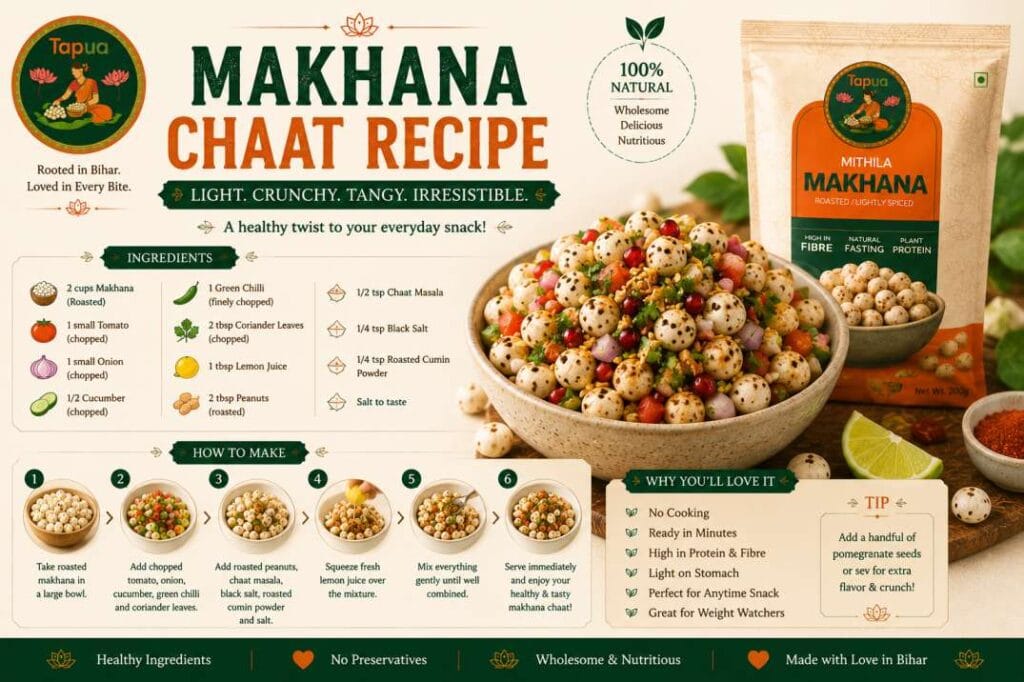
Four o’clock, rain on the window, and the fridge has curd, leftover roasted makhana, and not much else. That is close to the entire ingredient list for this chaat. Ghee-roasted phool makhana goes into a sweetened curd base, gets topped the way you would top any bhel: chutneys, raw onion, a fistful of sev, and the whole thing is ready in about twenty minutes.
What makes this worth keeping in rotation over a regular bhel puri is the bite. Puffed rice turns soft the moment curd touches it. Makhana holds its crunch a lot longer, so the chaat still has texture by the third spoonful and not just the first. It is a simple swap for anyone who wants the chaat experience without deep-fried puris, and it works as well for a light dinner as it does for an evening snack.
This makhana chaat recipe comes together in one pan and one bowl, with no special equipment and no ingredient you would need to hunt down. Below: why the texture holds up better than a regular bhel, the full ingredient list with a couple of easy swaps, a step-by-step method with a cook’s tip that actually changes the result, and answers to the questions that come up most often once people start making this on repeat.
Why makhana works in a dahi chaat
Phool makhana is mostly air once it has been roasted properly, hollow enough to float in curd without turning to mush the way puffed rice or papdi does. The roasting step matters more than it looks like it should. A raw or under-roasted piece goes chewy and slightly rubbery the moment curd touches it, while a fully crisp one keeps a faint hollow snap even after ten minutes sitting in the bowl.
A more even, larger grade of makhana helps too. The 5-Suta and 6-Suta pieces in a Tapua pack are sorted by hand for size, since the smaller broken bits are exactly what loses crunch first once they meet anything wet. Bigger, uniform pieces give you a better mouthful: makhana, dressing, and sev together in one spoon, rather than mostly dressing with a few stray crumbs.
There is also a genuinely practical eating point here, not just a texture one. A curd-and-makhana base carries a fraction of the oil of a fried-papdi bhel, so it sits lighter as a four o’clock snack and does not leave you sluggish before dinner the way a plate of fried chaat sometimes does.
None of this requires special-occasion ingredients. If you already keep a pack of roasted Tapua makhana around for evening snacking, you are most of the way to this chaat without having planned for it at all. The only step that takes any attention is the roasting, and even that is a five-minute job once the ghee is hot.
What You’ll Need
Main ingredients:
- 1.5 cups Tapua phool makhana
- 2 tsp ghee [or a neutral oil for a lighter version]
- 1 cup fresh curd (dahi), whisked smooth
- 2 tbsp sugar [adjust to taste, or skip for a tangier, less sweet chaat]
- Green chutney, to taste
- Sweet tamarind chutney, to taste
- Red chilli powder, a light dusting
- Chaat masala, a light dusting
- Roasted jeera (cumin) powder, a light dusting
Garnishes, to serve:
- Raw onion, finely chopped, a small handful
- Coriander leaves, a few sprigs, chopped
- Sev, a generous handful [swap for roasted peanuts for a gluten-free version]
Instructions
The whole method splits into two short stages: roast and cool the makhana, then build the chaat. Nothing here needs precision timing, just attention to how the makhana looks and sounds as it roasts, since that tells you far more than a clock would.
- Heat the ghee in a small kadai or pan over a low to medium flame.
- Add the makhana and roast, stirring more or less constantly, until the pieces turn a shade darker and sound dry and hollow when you stir them. Press one between two fingers. It should snap and break cleanly rather than bend.
Cook’s tip: Let the roasted makhana cool to room temperature before it goes anywhere near the curd. Warm makhana straight off the flame steams gently inside the bowl, and that trapped warmth is the actual difference between a chaat that stays crunchy through the last bite and one that turns soft in ten minutes.
- Turn off the flame and tip the roasted makhana onto a plate to cool completely, spread out in a single layer so the heat escapes faster.
- In a mixing bowl, whisk the curd and sugar together until completely smooth, with no lumps anywhere.
- Add the cooled makhana to the curd and fold gently until every piece is coated.
- Transfer to a serving bowl. Spoon the green chutney and tamarind chutney over the top, then sprinkle on the red chilli powder, chaat masala, and roasted jeera powder.
- Finish with the chopped onion, coriander leaves, and a generous layer of sev on top.
- Serve immediately, while the makhana still has its crunch.
Serving Makhana Chaat
This chaat is built to be eaten right away, so the timing only matters at the table and not before. Treat it as a fifteen-minute snack between calls, a starter ahead of a heavier dinner, or the cooling counterpart to something spicier on a warm, humid evening. It travels reasonably well to a small gathering too, as long as you carry the curd, the roasted makhana, and the toppings separately and assemble individual bowls only once people are ready to eat.
For a heartier plate, add boiled potato cubes, boiled black chana, or pomegranate seeds. All three play well against the tang of the curd and turn this from a snack into something closer to a light meal. A squeeze of lime at the end brightens the whole bowl if your curd leans more sweet than sour.
A few easy variations are worth knowing once the base method is familiar. Swap the curd for hung curd if you want a thicker, almost raita-like base. Add boiled sweet corn or grated carrot for crunch that survives even longer than the makhana’s own. For a Navratri or Ekadashi-friendly version, drop the onion, swap regular salt for sendha namak, and check your chutneys for garlic before serving.
Storing the Components
The assembled chaat itself does not keep. The makhana softens within the hour once it is sitting in curd, no matter how crisp it was going in. What does keep is the roasted makhana on its own: cooled completely and sealed in an airtight container, it stays crisp for about a week at room temperature, away from direct sunlight or any source of moisture.
The practical move is to roast a larger batch of plain makhana ahead of time, store it as above, and whisk fresh curd whenever the craving shows up. From there, assembling one bowl takes about five minutes, most of which is just spooning on the toppings.
If you do end up with a bowl that has been sitting for a while and the makhana has gone soft, it is not a wasted batch. Spread it on a plate and let any excess curd drain off, then use it as a base for a quick raita or mix it into a bowl of poha the next morning, where the texture stops mattering as much.
Questions People Ask
Can I make this without sugar in the curd?
Yes. The sugar simply rounds off the curd’s sourness. If your curd is already mild, or you would rather keep the whole thing savoury, leave the sugar out and lean a little more on the sweet tamarind chutney instead.
Is makhana chaat a good fasting-day food?
It can be, with a couple of swaps. Use sendha namak instead of regular salt, skip the onion, and check that your chutneys do not contain garlic, and it fits most vrat formats. Plain roasted makhana on its own is already a common fasting snack in Bihar, for exactly this reason.
What can I use instead of sev for a gluten-free version?
Roasted peanuts or coarsely crushed roasted makhana both add a similar crunch on top without the gram-flour sev. Pomegranate seeds work too, for crunch plus a different kind of tang.
How is this different from a regular bhel puri?
Bhel puri leans on puffed rice and papdi, both of which lose their texture within minutes of meeting any wet chutney. Makhana holds its bite for far longer and carries less oil overall, which is really the whole reason to make the swap in the first place.
Can I use store-bought curd for this?
Yes, as long as it is fresh and not overly sour. If it tastes sharp on its own, the sugar in the recipe becomes more useful for balancing it out, and a touch of fresh cream stirred in helps round out thinner, watery curd.
Why did my makhana go soft instead of staying crunchy?
Almost always one of two reasons: the makhana was not roasted until fully crisp before it met the curd, or it sat in the curd too long before serving. Roast until a piece snaps cleanly when pressed, let it cool completely, and serve within a few minutes of mixing.
Once you have made this a couple of times, the ratio of curd to makhana stops being a measurement and becomes a feel: more curd for a softer bite, less for something closer to a dry chaat. Either way, it tends to disappear from the bowl faster than bhel puri ever did at our table.