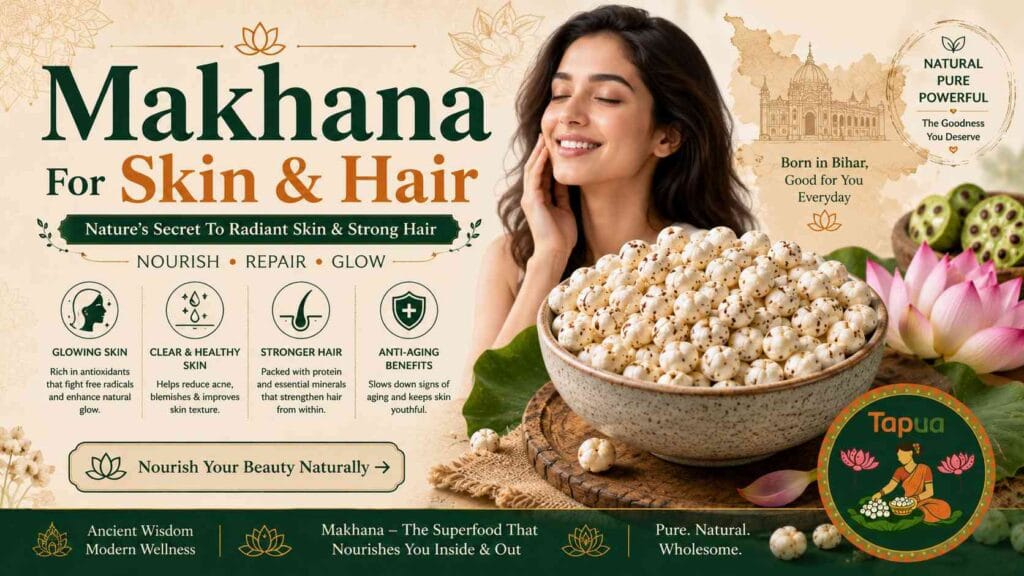
Skin and hair benefits show up on almost every list of makhana benefits floating around online, usually backed by nothing more specific than “it’s rich in antioxidants and protein.” That’s true as far as it goes, but it’s also vague enough to be said about a lot of foods.
This post looks at what’s actually behind the claim: which nutrients in makhana are genuinely relevant to skin and hair, what the broader science on those nutrients says, and where the connection to makhana specifically gets thin. Short version: there’s a reasonable case for skin, a much weaker one for hair, and no study that has tested makhana on either outcome directly.
What’s Actually in Makhana That’s Relevant Here
Makhana contains a handful of antioxidant compounds, including gallic acid, ellagic acid, and epicatechin, along with a meaningful amount of plant protein for a snack food, roughly 9 to 10 grams per 32-gram serving.
Antioxidants matter for skin because oxidative stress, damage caused by free radicals building up faster than the body can clear them, is one of the well-documented contributors to visible skin aging: fine lines, dullness, loss of elasticity. That mechanism is established dermatological science, separate from makhana entirely. Protein matters for hair because hair is largely made of keratin, a structural protein, and a diet genuinely low in protein can show up in hair quality over time. Both of these are real, general nutrition facts. What’s missing is a study that connects eating makhana specifically to a measurable skin or hair outcome in real people.
The Case for Skin: Reasonable, Still Indirect
The clearest version of this claim goes: makhana contains antioxidant compounds, antioxidants help counter oxidative stress, oxidative stress contributes to skin aging, therefore makhana may support skin health. Each link in that chain is individually reasonable.
That source confirms the antioxidant content and discusses it mainly in relation to general free-radical protection and chronic disease risk, not skin specifically. No clinical study has measured skin outcomes in people who eat makhana regularly versus those who don’t. That gap doesn’t make the claim false. It means the claim is plausible and consistent with broader nutrition science, not proven on its own terms.
The Case for Hair: Thinner Than It’s Made Out to Be
The protein-for-hair argument gets repeated often but rests on weaker ground. Hair needs adequate overall protein intake to grow and stay strong, and severe protein deficiency genuinely does affect hair, but that’s a statement about diets that are protein-deficient overall, not about adding one moderately protein-rich snack on top of an already adequate diet.
Most people eating a varied Indian diet, dal, milk, eggs, or meat included, are not protein-deficient enough for makhana specifically to move the needle on hair quality. There’s no study isolating makhana’s effect on hair growth, thickness, or shedding. The honest answer is that makhana fits into an overall good diet, and a good diet supports hair, but the link is several steps removed and not specific to makhana at all.
Where This Leaves a Skincare or Haircare Routine
Eating makhana as a regular snack is a reasonable, low-cost addition to a diet that already supports skin and hair health through variety, hydration, and adequate protein and micronutrients overall. It isn’t a substitute for sunscreen, a dermatologist’s advice for an actual skin condition, or a doctor’s input on hair loss that has a medical cause, like a thyroid issue or iron deficiency.
That post covers the wider, better-supported health benefits if skin and hair specifically were what brought you here, since the strongest evidence for makhana sits elsewhere, in things like blood sugar response and protein content generally.
Where the Protein Actually Comes From
The protein and antioxidant content in Tapua makhana traces back to Mallah farming communities in Mithila, who’ve harvested makhana from wetland ponds for generations, long before anyone was marketing it for skin or hair. The nutrition was always there. What’s changed is how it gets talked about online, not what’s actually in the seed.
Common Questions
Does makhana really improve skin glow?
Not in a way any study has measured directly. It contains antioxidants that are broadly relevant to skin health through reducing oxidative stress, but no research has tested makhana specifically against a visible skin outcome like glow or texture.
Can eating makhana stop hair fall?
There’s no evidence for this. Hair fall has many causes, including thyroid issues, iron deficiency, stress, and genetics, most of which a snack food doesn’t address. See a doctor if hair fall is sudden or heavy rather than relying on diet changes alone.
How much makhana would I need to eat to see a skin benefit?
There’s no established amount, because no study has set out to measure this in the first place. A regular handful as part of a varied diet is reasonable; eating large quantities specifically chasing a skin outcome isn’t supported by anything in the research.
Is makhana better for skin than other nuts and seeds?
Not clearly. Many nuts and seeds, almonds and flaxseed among them, have their own documented antioxidant and nutrient profiles. Makhana isn’t uniquely positioned for skin benefits; it’s one reasonable source among several.
Are there any skin or hair risks from eating too much makhana?
Not specifically for skin or hair, though eating large quantities of any snack, including makhana, can contribute to excess calorie intake over time.
That post covers the general safety considerations.
This isn’t the most exciting answer to give about skin and hair, but it’s the accurate one: makhana is a genuinely healthy snack with real antioxidants and protein, grown by the same Mallah families who’ve worked these ponds for generations, and that’s worth something on its own, without needing to claim more than the evidence backs up.