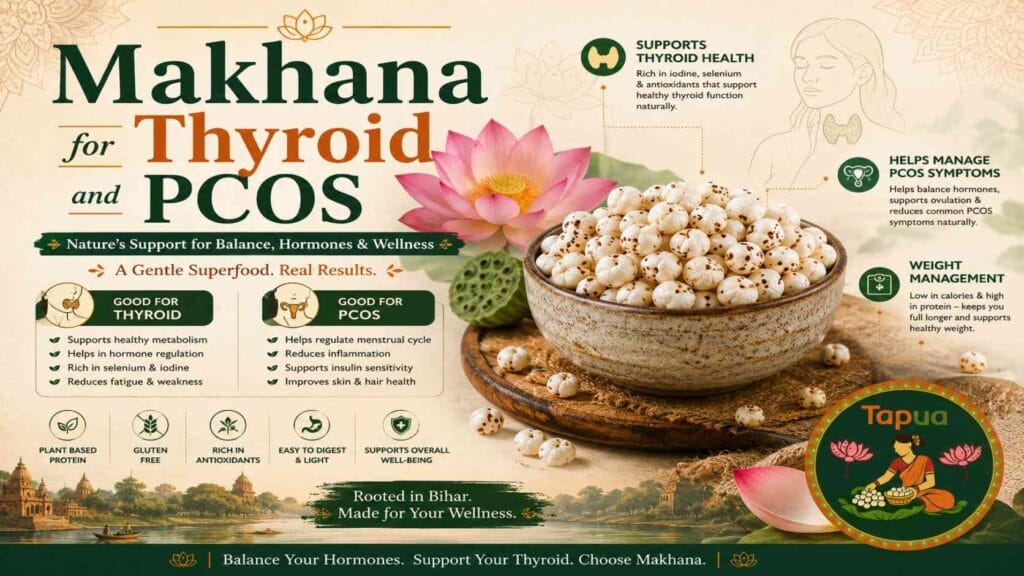
Search “makhana for thyroid” or “makhana for PCOS” and you’ll find a long list of articles promising specific benefits, usually pointing to selenium or some other single nutrient as the reason. Most of those claims don’t hold up well once you check the actual nutrition data, which is frustrating if you came here looking for a straight answer.
The honest version is less dramatic but more useful: makhana isn’t a treatment for either condition, and no credible source claims it should replace medication or a doctor’s guidance. What it can genuinely offer is a snack that fits well into how thyroid and PCOS are usually managed day to day, low in calories, low on the glycaemic index, and reasonably filling. This post walks through what’s actually supported, what’s repeated without a source, and where makhana realistically fits if you’re managing either condition.
The Selenium Claim You’ll See Everywhere, and Why It’s Weak
A lot of articles claim makhana supports thyroid function because it’s “rich in selenium”, a mineral the thyroid genuinely does need to produce its hormones. The problem is that makhana isn’t actually a notable source of selenium.
Reliable, medically reviewed nutrition data on makhana lists protein, fibre, magnesium, and potassium as its standout minerals; selenium doesn’t appear in meaningful amounts in the data available from those sources. The claim appears to have spread between similar-sounding articles rather than tracing back to an actual lab analysis or clinical source. If selenium intake is a genuine concern for thyroid health, foods like Brazil nuts, fish, and eggs have well-documented selenium content. Makhana doesn’t compete on that front, and it’s worth being told that plainly rather than reading it somewhere with more confidence than the evidence supports.
Where Makhana Genuinely Fits for PCOS: Blood Sugar
PCOS is closely tied to insulin resistance for a large share of people who have it, which is why blood sugar management is often part of managing the condition alongside a doctor’s care. Early research, mostly small animal studies rather than human clinical trials, has looked at compounds in makhana extract and found some signal that they may help regulate blood sugar response.
That source covers this research and is upfront that it’s still early: the studies involved mice and rats, not people, and a snack isn’t the same as a concentrated extract. What’s more directly useful is makhana’s low glycaemic index and modest calorie count, which make it a reasonable swap for higher-GI snacks in a PCOS-friendly diet without needing to lean on the extract research at all.
That post goes deeper into the blood sugar angle generally.
Where Makhana Genuinely Fits for Thyroid Conditions: Weight and Calories
Hypothyroidism in particular often comes with a slower metabolism and a tendency to gain weight more easily, which is one of the more practical, day-to-day frustrations people manage alongside their medication. Makhana’s appeal here has nothing to do with hormones directly.
It’s a low-calorie, low-fat snack with a reasonable amount of protein and fibre for its size, roughly 106 calories and about 10 grams of protein per 32-gram serving according to nutrition data, which makes it easier to manage portions and stay satisfied between meals without the calorie cost of most packaged snacks.
That post covers this side of things in more detail. None of this affects thyroid hormone levels directly. It just makes the weight-management part of living with a thyroid condition a little easier.
What This Doesn’t Mean
It doesn’t mean makhana can replace levothyroxine, metformin, or whatever else a doctor has prescribed. It doesn’t mean eating more of it will fix a hormonal imbalance, regulate periods, or reverse insulin resistance on its own.
Thyroid and PCOS are diagnosed and managed by a doctor, usually with bloodwork involved, and a snack food, however genuinely healthy, sits well outside that picture. The honest claim is a modest one: makhana is a reasonably good snack to have around if you’re already managing either condition, not a treatment for either one.
Questions People Ask
Does makhana help with hypothyroidism?
Not directly. It has no meaningful selenium or iodine content, the two minerals most tied to thyroid hormone production, despite some articles suggesting otherwise. Its real benefit is being a low-calorie snack that fits easily into the diet changes often recommended alongside thyroid medication.
Can makhana help regulate periods in PCOS?
There’s no direct evidence for this. The closest genuine link is through blood sugar management, since insulin resistance affects many people with PCOS, and makhana’s low glycaemic index makes it a sensible snack choice within that broader approach, not a treatment that affects hormones on its own.
Is makhana good for weight gain caused by thyroid issues?
Indirectly, yes, in the sense that it’s a filling, low-calorie snack that can replace higher-calorie options without leaving you hungry. It won’t change how your thyroid is functioning, but it can make the calorie side of weight management a bit easier to stick to.
Should I eat makhana instead of taking my thyroid or PCOS medication?
No. Nothing in the available research suggests makhana can substitute for prescribed medication for either condition. Treat it as a snack choice within a broader plan your doctor is already managing, not a replacement for any part of that plan.
How much makhana is safe to eat with these conditions?
There’s nothing condition-specific here; the general guidance of a handful, around 30 grams, a day as a snack applies.
That post covers general safety limits, including for people on certain medications, which is worth checking if you take regular prescriptions.
Tapua makhana comes from a village of the same name in Mithila, and nothing about where it’s grown changes what it can or can’t do for a thyroid or PCOS diagnosis. It’s still just a snack, a genuinely good one, that happens to fit reasonably well into a day already built around managing either condition properly.