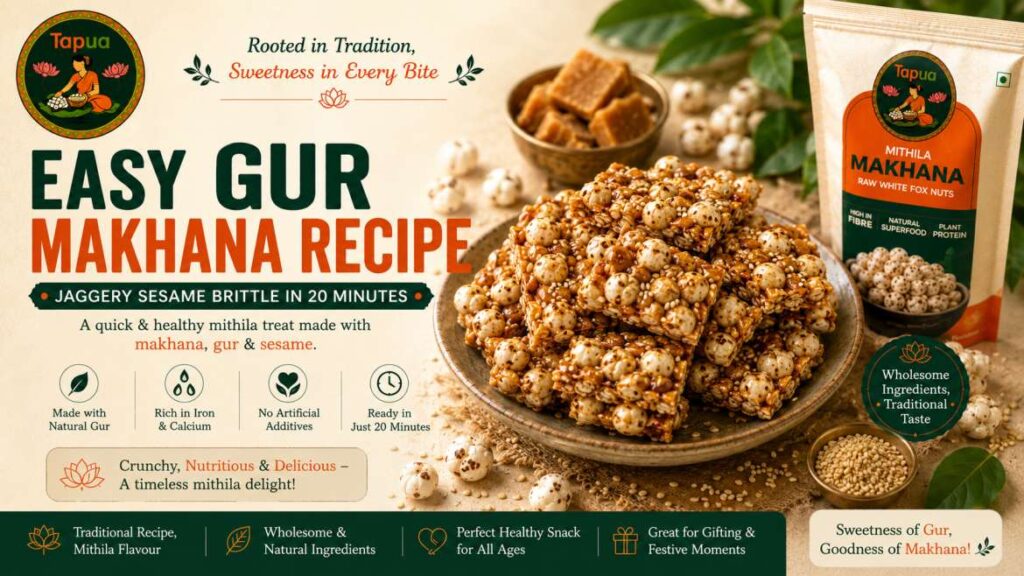
Jaggery and sesame turn roasted makhana into something closer to a brittle than a snack, with the kind of snap you get when sugar sets hard around something crunchy. This gur makhana recipe uses the same hard-ball sugar test that jaggery sweets have relied on for generations, a test that takes seconds once you have done it a few times but trips up most people on the first try.
Ready in about 20 minutes, this gur makhana recipe is a Bihar winter staple dressed in fennel, dry ginger, and black salt, warming spices that make sense once the weather turns cold and a sweet snack with a bit of bite to it sounds better than anything from a packet. Tapua’s makhana, harvested by Mallah families from wetland ponds across Mithila, takes to the jaggery coating well, a pairing that has been part of winter snacking here for longer than anyone keeps track of.
[Table of Contents: auto-generated by WordPress plugin]
[Image: Gur makhana brittle with sesame seeds and jaggery coating piled in a dark bowl | ALT: “gur makhana recipe in a bowl, jaggery sesame brittle”]
Why Jaggery Sesame Makhana Works
Jaggery brings a mineral, almost smoky sweetness that white sugar does not have, and it is exactly the kind of sweetness that holds up against black pepper and dry ginger without turning cloying. Sesame adds a second layer of nuttiness underneath the makhana’s own mild flavour, while fennel and black salt round the whole thing off so it tastes like a spiced sweet rather than plain candy.
The texture is the real trick of this gur makhana recipe. Jaggery that is cooked to the right stage sets into a hard, glassy coating almost immediately on contact with air, which is what gives the finished snack its brittle snap instead of a sticky, chewy bite. [External link: jaggery composition and how it differs from refined sugar → “Authoritative source on jaggery”] explains the chemistry in more detail if you are curious why the hard-ball test matters as much as it does.
Fennel and dry ginger are doing more than adding flavour on top. Both have a long history in Indian winter cooking specifically because they are considered warming, and pairing them with a sugar-heavy sweet is a fairly old trick for balancing something rich with something that settles the stomach afterward. Whether or not you put much weight on that tradition, the flavour pairing works on its own merits.
Ingredients
For roasting
- 1 tbsp ghee (for roasting makhana)
- 4 cups (100g) makhana (fox nuts)
For the jaggery coating
- 1 tbsp ghee (for jaggery)
- ½ cup (125g) jaggery (gur), grated or powder
- ½ tsp baking soda
- ¼ cup (35g) sesame seeds
- 2 tsp saunf (fennel seeds)
- ½ tsp black pepper powder
- 1 tsp ginger powder (saunth/dry ginger)
- 2 pinches black salt (kala namak)
- Pinch of regular salt
Saunth is simply dried, ground ginger, the same jar most kitchens already keep for kadha or winter tea, so there is no need to hunt down anything unusual. Black salt has a slightly sulphurous edge that plain salt does not, and it is what gives this gur makhana recipe its faintly savoury back note. If you only have regular salt on hand, use a touch more of it; the result will be sweeter and less complex but still good. Pre-grated jaggery sold in plastic packets tends to be softer and melts a little faster than a hard block you grate yourself, so keep an eye on the timing either way rather than going strictly by the clock.
[Image: Ingredients for gur makhana, makhana, jaggery, sesame seeds, saunf and spices laid out | ALT: “ingredients for gur makhana recipe”]
| Cook’s tip: Don’t skip the water test. Jaggery that hasn’t reached the hard-ball stage will give you sticky, chewy makhana that clumps. Overcooked jaggery tastes bitter. Two minutes of attention here is the whole recipe. |
How to Make It
- Heat 1 tablespoon ghee in a kadhai over medium flame. Add the makhana and roast, stirring constantly, until they’re fully crunchy and slightly coloured, about 8-10 minutes. Remove to a plate.
- In the same kadhai, heat the second tablespoon of ghee over low-medium flame. Add the grated jaggery and stir as it melts. The mixture will bubble as it heats.
- Test for set: drop a small amount of the liquid jaggery into a glass of cold water. If it forms a hard ball that doesn’t bend, it’s ready. If it’s still soft, cook another 30 seconds and test again.
- Once the jaggery reaches the hard-ball stage, add the baking soda and stir quickly. It will foam up briefly. Work fast from here.
- Add the roasted makhana, sesame seeds, black pepper, ginger powder, black salt, saunf, and pinch of salt. Stir vigorously to coat every piece. The jaggery sets fast as it cools, so move with purpose.
- Pour onto a flat tray or baking sheet. Spread out as quickly and evenly as you can. Let it cool completely, about 15 minutes.
- Once cooled, the gur makhana will have set into a loose brittle. Separate any pieces stuck together with your hands and serve.
[Image: Jaggery caramelising in a kadhai with ghee, being tested by dropping in water | ALT: “jaggery hard-ball test for gur makhana recipe”]
The Hard-Ball Test, Explained
The hard-ball stage is a real candy-making term, not a Tapua invention, and it shows up in jaggery sweets across India for exactly this reason: jaggery does not behave like refined sugar syrup, and a thermometer reading alone will not tell you what you need to know. Dropping a bit into cold water and trying to shape it with your fingers is a faster, more reliable check than guessing from colour or smell.
If the ball you form flattens or smears between your fingers, it needs more time on the heat. If it shatters or feels grainy rather than smooth, it has gone slightly too far, though it is usually still rescuable if you move quickly. A clean, firm ball that holds its shape and barely gives when pressed is exactly what you are after before the baking soda goes in.
Serving & Storing
Serve gur makhana brittle broken into rough pieces rather than uniform squares; the uneven edges are part of its charm and it is not a recipe that benefits from looking too tidy. It pairs naturally with hot tea on a cold afternoon, and a small bowl of it travels well to a Sankranti or Lohri spread alongside other jaggery sweets.
Store in an airtight jar at room temperature, where it keeps well for up to two weeks; humidity is the only real enemy here, since jaggery pulls moisture from the air and softens the brittle’s snap over time. A silica packet or a few grains of raw rice tucked into the jar absorbs excess moisture and keeps the texture crisp for longer. A tin of Tapua gur makhana also makes a thoughtful, low-effort gift during the winter festival season, since it travels and keeps better than most homemade sweets.
If you are portioning it out as gifts, small paper cones or tied muslin pouches work better than one large jar, since they let you hand out single servings without anyone needing to dig through a shared container. It also means the brittle gets eaten sooner after opening, which keeps the texture at its best rather than slowly softening over the following days.
A Winter Kitchen Staple
Jaggery sweets follow the cold months across most of North India, and Mithila is no exception. Sugarcane is harvested and pressed into fresh gur right around the time the weather turns, which is also when warming spices like dry ginger and black pepper start showing up more often in everyday cooking, in tea, in pickles, and in sweets exactly like this one.
Makhana fits naturally into that pattern because the lotus ponds it comes from are harvested earlier in the year, so households already have a stock of dried makhana sitting in the kitchen by the time fresh jaggery starts arriving from the local mill. Pairing the two was never a deliberate invention so much as a practical use of whatever was on hand at the same time, which is true of a lot of older recipes once you trace them back far enough.
What keeps a recipe like this alive generation after generation is not nostalgia alone, it is that the jaggery and sesame combination genuinely works better in winter than the rest of the year. The brittle stays crisper in dry winter air and turns sticky faster in humid summer months, so making a batch in season is partly about flavour and partly about the snack actually holding its texture.
Common Mistakes to Avoid
The most common failure point is skipping the water test and guessing instead. Jaggery looks done well before it has actually reached the hard-ball stage, and the colour barely changes between an underdone batch and a properly cooked one, so the test is not optional if you want a brittle rather than a chewy toffee.
A close second is moving too slowly once the baking soda goes in. The foaming reaction is brief, and the jaggery starts setting within seconds of cooling, so have the makhana and spices measured and within reach before that step rather than scrambling to find them afterward.
Roasting the makhana unevenly is the third common issue. Stir constantly rather than occasionally, since a kadhai’s heat is rarely even across its surface, and a few underdone pieces will turn chewy once they meet the hot jaggery instead of staying crisp.
Spreading the mixture too thickly on the tray is the fourth. A thick layer cools unevenly and can stay soft in the centre even after the edges have set hard. Spread it out as thin as you reasonably can while it is still workable.
Using a tray that is still warm or wet from the last batch is the fifth, and an easy one to overlook. Any leftover moisture on the surface transfers straight into the jaggery as it sets, leaving soft patches where the tray was damp. Wipe the tray dry and let it cool to room temperature between batches if you are making more than one.
More Tapua Makhana Recipes to Try
If this gur makhana recipe fits the season, a couple of other Tapua recipes are worth keeping nearby. [Internal link: Makhana Kheer Recipe → “Makhana Kheer Recipe: Creamy Fox Nut Dessert”] is the other classic Bihar winter sweet built on the same fox nuts, just simmered rather than caramelised.
For something savoury to balance the sweetness, [Internal link: Masala Makhana Recipe → “Masala Makhana Recipe: Spiced Lotus Seed Snack”] takes about the same amount of time, and [Internal link: Roasted Fox Nuts Recipe → “Roasted Fox Nuts: 5 Easy Makhana Flavours”] is worth trying if you want a plainer base to compare the texture against.
Questions People Ask
Why is my gur makhana sticky instead of brittle?
The jaggery almost certainly did not reach the hard-ball stage before the makhana went in. Sticky, chewy results trace back to undercooked jaggery nearly every time, so if this happens, cook the next batch a little longer and test more frequently near the end.
Can I use sugar instead of jaggery?
You can, though it stops being a gur makhana recipe in anything but name once you do. White sugar sets harder and clearer, with none of jaggery’s mineral depth, and the cooking time to reach the hard-ball stage is usually a little shorter.
Why does the jaggery need baking soda?
The baking soda reacts with the hot jaggery to create tiny air bubbles, which is what keeps the finished brittle light rather than dense and glassy. Skipping it gives you a harder, more toffee-like texture rather than the airy snap this recipe is going for.
How long does gur makhana stay fresh?
About two weeks in a sealed container at room temperature, longer if your kitchen stays dry. The texture is the first thing to go; the flavour holds up well past that point, so a slightly softened batch is still worth eating even if it has lost some of its snap. If it does soften, a quick five-minute spell in a dry pan over low heat can bring back some of the crunch, though it will never be quite as crisp as the day it was made.
Can I make this without sesame seeds?
Yes, the sesame is there for texture and a background nuttiness rather than as a structural ingredient. Leaving it out makes a slightly plainer brittle, and a tablespoon of crushed peanuts works as a reasonable swap if you want some crunch in its place. White or black sesame both work equally well, so use whichever variety happens to be in the pantry.
Is gur makhana the same as makhana chikki?
They are close cousins. Chikki usually refers to a flatter, denser jaggery-and-nut bar that is pressed and cut into squares, while this gur makhana recipe sets more loosely into rough, separated pieces. Both rely on the same hard-ball jaggery technique underneath, and a fan of one will almost certainly enjoy the other, even though they look quite different on a plate.
Can I double this recipe for a festival batch?
Yes, but cook the jaggery in two separate batches rather than one large pot. A bigger volume of jaggery takes noticeably longer to reach the hard-ball stage, and the extra time on the heat raises the risk of it turning bitter before it gets there.
Why did my gur makhana turn out bitter?
The jaggery was almost certainly left on the heat past the hard-ball stage and started to caramelise too far, the same way sugar turns bitter once it crosses from amber into deep brown. Test earlier and more often near the end of cooking, since the jump from hard-ball to overcooked can happen within a matter of seconds.
Can I add dry fruits to this gur makhana recipe?
Yes, a small handful of chopped cashews or peanuts stirred in alongside the sesame seeds works well and adds a different kind of crunch against the brittle jaggery shell. Add them at the same step as the sesame so they get coated and set into the mixture rather than sitting loose on top.
Is gur makhana suitable for fasting days?
Largely, yes, since makhana itself is a traditional fasting food in many households, and jaggery, sesame, and ghee are all commonly permitted during most fasting customs. The specific rules vary by region and by individual fast, so it is worth checking against the particular fast being observed before serving it as a fasting snack.
[Image: Finished gur makhana pieces separated on a tray after cooling, golden and crunchy | ALT: “gur makhana recipe brittle cooling on a tray”]
Brittle like this has been coming off stoves in Mithila every winter for longer than anyone bothers to date it. The jaggery and sesame just make sure it never lasts as long around the house as whoever made it intended. Make a batch once the weather turns, keep it within reach of the tea kettle, and it tends to disappear well before the jar would otherwise need restocking.e.