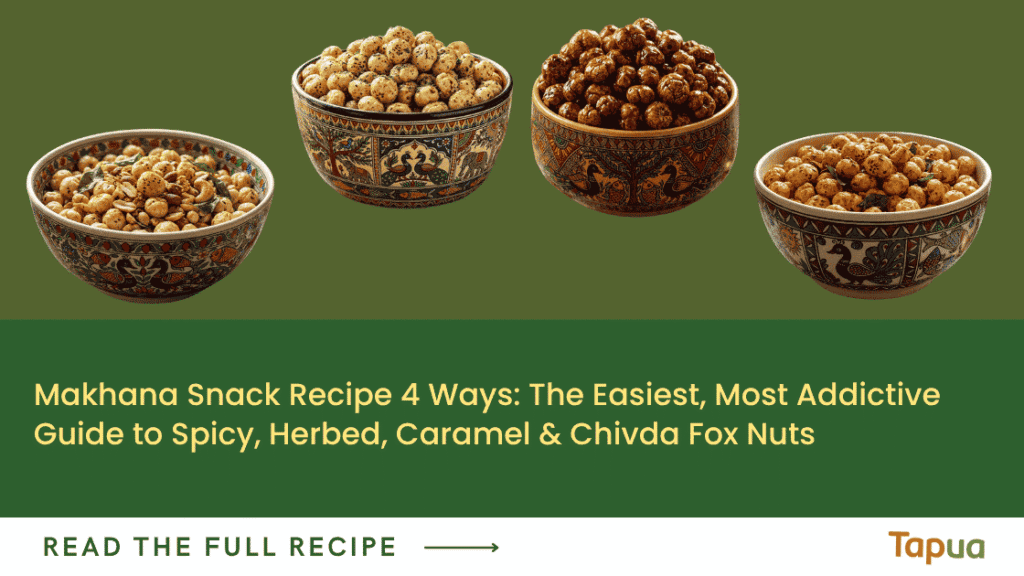
The makhana snack recipe most people attempt goes like this: tip fox nuts into a pan, sprinkle dry masala over hot makhana, shake the pan, eat. Result? Makhana that tastes plain with a few dusty orange pieces at the bottom of the bowl. The masala never sticks — and nobody explains why.
This guide fixes that with a single technique — the spice paste method — and then shows you four completely different makhana snack recipes that each use it in their own way: a spicy masala version, an aromatic herbed curry leaf version, a sweet caramel version with jaggery, and a full makhana chivda that works as a party snack or a week-long tea-time staple. All four are ready in under 15 minutes. All four actually taste like the flavour the label promises.
Tapua makhana is sourced directly from 200+ farming families in Mithila, Bihar — traditionally processed with no added oils. It’s the ideal base for all four of these makhana snack recipes because the surface is consistently porous, and that’s what makes the paste technique work so well.
Table of Contents
- The Secret Technique: Why a Paste Beats Dry Powder Every Time
- Makhana Snack Recipe #1: Spicy Masala Makhana
- Makhana Snack Recipe #2: Herbed Curry Leaf Makhana
- Makhana Snack Recipe #3: Caramel Sweet Makhana with Jaggery
- Makhana Snack Recipe #4: Makhana Chivda (The Festive Version)
- Serving & Storage for All 4 Versions
- Makhana Snack Nutrition — What You’re Actually Eating
- Troubleshooting Common Makhana Snack Problems
- FAQs
The Secret Technique: Why a Paste Beats Dry Powder Every Time
Dry spice won’t stick to a dry surface. Makhana is light, airy, and its surface has almost nothing for loose powder to grip. This is why most homemade spiced makhana loses all its flavour within minutes of leaving the pan.
The solution is simple: mix your dry spices with a small amount of water — just enough to make a thick paste, not a soup — and rub that paste directly onto the raw makhana before it goes in the pan. As the makhana roasts, the water evaporates and the spices bake onto the porous surface. The flavour stays put.
The paste consistency is the critical variable. Think hummus, not chutney. Thick enough to cling to a spoon when you lift it, thin enough to rub evenly without tearing the makhana. Start with less water than you think you need — you can always add a few drops more, but you can’t take it back. Too much water and the makhana will steam and soften instead of crisping.
This technique works for the spicy, herbed, and chivda recipes below. The caramel version uses a jaggery syrup instead — a different sticky medium, same principle.
Makhana Snack Recipe #1: Spicy Masala Makhana
The base recipe and the one to start with. Once you have the spicy version right, the others follow naturally. This is also the version you can make completely oil-free — the paste carries the spice without needing any fat.
Prep time: 2 minutes | Cook time: 7–8 minutes | Serves: 2
Ingredients
- 2–2½ cups (35–40g) makhana fox nuts
- ½ tsp Kashmiri chilli powder (or paprika for lower heat)
- ½ tsp garlic powder
- ¼ tsp salt (start with less, taste and adjust)
- ⅓ tsp garam masala or chaat masala
- ¾–1 tbsp water (add in two stages — critical not to over-add)
- 1 tsp ghee or oil (optional, added at the end for richness)
Instructions
- Combine all dry spices in a small bowl. Taste the mix before adding water — adjust salt and chilli now before anything touches the makhana.
- Add water in two small pours, stirring between each. The paste should coat a spoon without dripping. If it slides off easily, it’s too wet.
- Place the makhana in a wide, ungreased pan (cold). Pour half the paste over them. Using both hands, rub the paste gently onto every piece — work quickly. Add the remaining paste and repeat. Every piece should show colour.
- Place the pan over low to medium-low heat. Stir or toss every 30–45 seconds for 7–8 minutes. The makhana will lighten in colour and feel noticeably crisper.
- If adding ghee, push the makhana to the sides, add ghee to the centre, fold through, and roast one more minute.
- Turn off the heat. Leave the makhana in the pan to cool — they crisp further as the residual heat dissipates. Test by pressing between two fingers: a properly done piece crumbles and powders. It should not bend.
💡 Tip: The most common mistake is using high heat to speed things up. This scorches the spice on the outside while leaving the centre soft and chewy. Low heat, patience, and constant stirring is the only reliable method.
Makhana Snack Recipe #2: Herbed Curry Leaf Makhana
This is the makhana snack recipe for people who want something aromatic rather than spicy. Curry leaves, roasted to a fine powder, give the makhana a deep, savoury herb flavour that pairs exceptionally well with chai. You can substitute dried mint, moringa powder, or dried coriander if curry leaves aren’t available — each gives a completely different character.
Prep time: 3 minutes | Cook time: 8 minutes | Serves: 2
Ingredients
- 2–2½ cups (35–40g) makhana
- ½ tbsp curry leaves powder (see note below for making your own)
- ½ tsp cumin powder
- ½ tsp garlic powder
- ¼–⅓ tsp salt
- ¼–½ tsp black pepper powder (leave out for a mild version)
- 1 tbsp water (to make the paste)
- 1 tsp ghee or neutral oil (added mid-cook — essential for this version)
- Extra ½ tbsp curry leaves powder (to finish)
How to Make Quick Curry Leaves Powder
If you have fresh curry leaves, dry them at room temperature for 2–3 days or in the oven at 80°C for 20 minutes. Once bone dry and crumbly, grind to a fine powder in a spice grinder or blender. Store in an airtight jar — it keeps for months and is one of the most useful pantry staples you can make. Finer grind = better coating on the makhana.
Instructions
- Combine curry leaves powder, cumin, garlic powder, salt, and pepper in a bowl. Mix well.
- Add water in two additions to make a thick paste. This one is slightly more forgiving than the masala version — the herb powder absorbs water well — but still aim for a hummus-like consistency.
- Rub the paste all over the makhana the same way as the spicy version. Every piece should show green-grey colour.
- Roast on low to medium-low heat, stirring continuously, for 6–7 minutes.
- When almost crisp, make a space in the centre of the pan. Add the ghee or oil and the extra ½ tbsp curry leaves powder. Stir through the makhana and roast for another 1–2 minutes until fragrant and crunchy.
- Turn off heat and cool in the pan. The herbed makhana will smell deeply aromatic as it cools. Serve at room temperature — the flavour is better once fully cooled.
💡 Tip: For children or people who find the curry leaf flavour too strong, substitute half the curry leaves powder with mild dried mint powder. It produces a fresher, milder herbed makhana that packs well in lunchboxes.
Makhana Snack Recipe #3: Caramel Sweet Makhana with Jaggery
This is the makhana snack recipe that converts sceptics. People who think they don’t like makhana will reliably eat half a bowl of this before they’ve realised what they’re doing. Jaggery melts into a light caramel coating that sets as it cools, giving the makhana a subtle sweetness and a slightly sticky crunch. Unrefined jaggery powder — the kind that’s slightly dark and earthy — gives the deepest flavour. Regular grated jaggery works too.
Prep time: 1 minute | Cook time: 10 minutes | Serves: 2
Ingredients
- 2 cups (30g) makhana
- 5–6 tbsp jaggery powder (¼ cup + 2 tbsp — adjust to your sweetness preference)
- ½ tbsp water (just enough to dissolve the jaggery)
- ¼ tsp cardamom powder (or ¼ tsp vanilla extract — not essence)
- ½–¾ tbsp ghee (optional but adds rich flavour and helps the coating)
- 1 tbsp crushed roasted peanuts, sesame seeds, or coconut flakes (optional — adds texture)
Instructions
- Dry roast the makhana first. In a wide pan over low to medium-low heat, roast the makhana for 6–7 minutes, stirring continuously, until fully crispy. Transfer to a plate or tray and let cool. Do not skip this step — the makhana must already be crispy before it meets the jaggery syrup.
- In the same pan, add the jaggery powder, water, and cardamom. Mix with a spoon.
- Cook on low heat without stirring until the jaggery begins to bubble — just 1–2 minutes with this small amount of liquid. Watch carefully: jaggery burns quickly and there’s very little margin between “just right” and “bitter”. As soon as you see consistent bubbling, turn off the heat immediately.
- Add the optional peanuts or coconut flakes, then quickly add the roasted makhana. Toss rapidly to coat — use two spoons or a spatula and work fast, as the jaggery starts to set within 30 seconds of coming off the heat.
- Add ghee if using, stir through, and return to very low heat for just 1–2 minutes to bring everything together and ensure the makhana are still crispy under the coating.
- Spread on a plate or tray to cool. The jaggery coating hardens as it cools and sets into a light caramel shell. Eat within 2 days — this version softens fastest in humidity.
💡 Tip: If the jaggery seizes into hard lumps rather than coating the makhana, the syrup was overcooked or the makhana was added too late. The fix: add 1–2 tsp of warm water to the pan and return to very low heat, stirring gently until the jaggery loosens and coats again.
Makhana Snack Recipe #4: Makhana Chivda (The Festive Version)
Chivda is an Indian mixed dry snack — traditionally made with flattened rice (poha) or puffed grains, tempered with curry leaves, dried chilli, nuts, and coconut. Makhana chivda replaces the grain base with fox nuts, making it lighter, higher in protein, and — once you’ve tried it — better in every way.
This is the most involved of the four makhana snack recipes, taking about 15 minutes, but it keeps for 5–7 days in an airtight container. Make a large batch on Sunday and you have snacks for the week. It’s also the one that impresses guests most — the tempering aroma alone is enough to draw people into the kitchen.
Prep time: 3 minutes | Cook time: 12–15 minutes | Serves: 4–6
Ingredients for the Makhana Base
- 2 cups makhana (you can use whole or sliced — see note below)
- ½ tsp Kashmiri chilli powder
- ½ tsp garlic powder
- ¼ tsp salt
- ⅓ tsp garam masala
- ¾–1 tbsp water (for the paste)
Ingredients for the Tempering
- 1½ tbsp oil (coconut or groundnut oil works best for flavour)
- 3–4 tbsp raw peanuts
- 10–12 cashews, halved
- 1 dried red chilli, broken in half
- 2 tbsp sliced copra (dried coconut) — skip if unavailable, sub with coconut flakes
- 3 garlic cloves, lightly crushed
- 1 sprig fresh curry leaves (pat dry before using — water in the pan causes sputtering)
- ¼ tsp red chilli powder
- ⅛ tsp turmeric
- Salt to taste (remember the makhana base already has salt)
Instructions
- Prepare the makhana base: make the same spice paste as the masala recipe. Coat the makhana, then roast on low to medium-low heat for 7–8 minutes until crispy. Transfer to a plate and set aside.
- Sliced vs whole makhana: for chivda, sliced makhana is traditional and preferred. Slice using the slicing blade of a food processor or chop roughly with a knife. The irregular pieces and crumbs all add texture — keep everything including the fine powder.
- Make the tempering: heat oil in a wide pan over medium heat. Add peanuts and fry, stirring, until golden (2–3 minutes). Add cashews, dried chilli, and copra. Fry until the cashews are golden and the coconut is lightly brown — another 1–2 minutes.
- Push everything to the side. Add crushed garlic and curry leaves (stand back — the curry leaves will spit). Fry until the garlic is golden and the leaves are completely crispy (about 1 minute).
- Turn off the heat. Add red chilli powder, turmeric, and a light pinch of salt. Stir through quickly — the residual heat is enough to cook the raw spice without burning it.
- Add the roasted spiced makhana to the tempering pan. Toss everything together until the makhana is evenly coated with the tempering oil and spices.
- Cool completely before serving or storing. The flavours settle and deepen as the chivda cools. Serve at room temperature — never warm. The chivda will be better the next day than the day it’s made.
💡 Tip: For a Navratri vrat version: skip the garlic and use sendha namak (rock salt) instead of regular salt. Use ghee instead of oil for the tempering. Omit the dried chilli if your fast doesn’t permit it. All four makhana snack recipes can be adapted for fasting with minor substitutions.
Serving & Storage for All 4 Makhana Snack Recipes
Each version has its own best serving window and storage behaviour:
- Spicy Masala: Serve warm or at room temperature. Stores 5–7 days in an airtight glass container. Re-crisps easily in a dry pan for 2–3 minutes if it softens.
- Herbed Curry Leaf: Better at room temperature than warm — the curry leaf flavour comes forward as it cools. Stores 5–7 days. Re-crisps well.
- Caramel Jaggery: Eat within 2 days — the jaggery coating is hygroscopic and softens faster than the other versions. Does not re-crisp well after softening. Make small batches.
- Makhana Chivda: The longest keeper — 7 days in glass. Flavour peaks on day 2. Do not refrigerate any version; fridge humidity softens makhana rapidly.
General rule: always store makhana snacks in glass, not plastic, away from moisture, and never seal the container while the makhana is still warm.
Makhana Snack Nutrition — What You’re Actually Eating
Per 30g serving of plain roasted makhana (base for all 4 recipes):
- Calories: ~104 kcal
- Protein: 2.9g (complete protein — all essential amino acids)
- Dietary Fibre: 4.4g
- Fat: 0.03g (essentially fat-free before oil/ghee is added)
- Carbohydrates: ~23g
- Glycemic Index: 38–42 (low — no blood sugar spike)
- Magnesium: ~63mg (~15% of daily requirement)
The caramel version adds ~45–60 calories per serving from jaggery. The chivda adds ~40–50 calories per serving from the oil tempering and nuts. Even in their richest forms, these makhana snack recipes are significantly lighter than any fried namkeen or biscuit alternative.
For a full nutritional breakdown of makhana as an ingredient, see our Makhana Nutrition guide and the nutritional analysis at Ayur Times.
Troubleshooting Common Makhana Snack Recipe Problems
The masala isn’t sticking
Almost always caused by one of two things: too little water in the paste (making it too dry to coat) or not rubbing the paste in thoroughly by hand before cooking. The rubbing step is not optional — it is how the paste gets into the porous surface. Don’t just drizzle and toss.
The makhana went soft, not crispy
Too much water in the paste, or heat was too high and the makhana steamed instead of dried. For the caramel version, softness usually means the jaggery syrup had too much water. Start over with a drier paste and lower heat.
The makhana shrank significantly during roasting
This happens when too much water was added to the paste. The makhana absorbs the moisture and then contracts as it evaporates. The texture is usually still fine, but the pieces will be smaller. Use less water next time — start with ½ tbsp and add drops from there.
The chivda tempering burned
The tempering sequence matters: peanuts first (they take longest), then cashews and coconut (medium time), then garlic and curry leaves last (they go from raw to perfect to burned in about 90 seconds). Keep the heat at medium — not high — and never leave the pan unattended once the curry leaves go in.
FAQs
Can I make a makhana snack recipe without oil?
Yes — the spicy masala version works completely oil-free. The paste carries the spice without any fat. For the herbed version, a small amount of oil or ghee improves the herb flavour significantly but can be skipped. The caramel version benefits from a small amount of ghee for the coating. The chivda requires oil for the tempering.
Which makhana snack recipe is best for kids?
The caramel jaggery version is the most universally loved by children — the sweetness makes it immediately familiar. The herbed version (with mint instead of curry leaves) is the mildest savoury option. Skip chilli and reduce salt for children in any version.
Can I make these makhana snack recipes in an air fryer?
Yes, for the spicy and herbed versions. After coating with the paste, air fry at 150–160°C for 6–8 minutes, shaking the basket every 2 minutes. The caramel version is difficult in an air fryer — the jaggery can drip and burn. The chivda tempering should be done on the stovetop regardless.
Which makhana is best for these snack recipes?
Large, uniform makhana (the “sutta” grade) roasts most evenly and holds texture through coating and tempering better than small, irregular pieces. Tapua sources and sells premium-grade, single-origin Mithila Makhana — specifically the quality that performs best in all four of these recipes. Explore options at tapuafoods.com/shop.
How long does the makhana snack stay crunchy?
In an airtight glass container at room temperature: spicy, herbed, and chivda versions last 5–7 days. Caramel version is best within 2 days. The moment you notice any softening, a 2–3 minute dry pan roast on low heat fully restores crunchiness — except for the caramel version, which doesn’t re-crisp well.
Can I use microwave to make makhana snack recipes?
For small batches, microwave roasting works: spread makhana on a microwave-safe plate and heat in 1-minute bursts at full power for 3–4 minutes total, stirring between each burst. Apply the spice paste before microwaving. The result is slightly less even than pan roasting but perfectly acceptable.
Four makhana snack recipes, one technique, and one ingredient that’s been hand-processed by farming families in Bihar for generations. The paste method makes the spicy version work. The jaggery syrup makes the caramel version addictive. The tempering makes the chivda the kind of thing people ask you to bring to every gathering.
The common thread across all of them — beyond the technique — is starting with makhana that’s worth the effort. Small, unevenly processed makhana gives uneven results. Large, properly sorted, single-origin makhana gives consistently excellent ones.
Try Tapua’s GI-tagged, single-origin Mithila Makhana — available at tapuafoods.com/shop. And for more makhana recipe ideas, visit our Recipes section.
Sources: Swasthi’s Recipes — Makhana Recipe 4 Ways | Ministry of Curry — Makhana Chivda | Ayur Times — Makhana Nutrition Facts