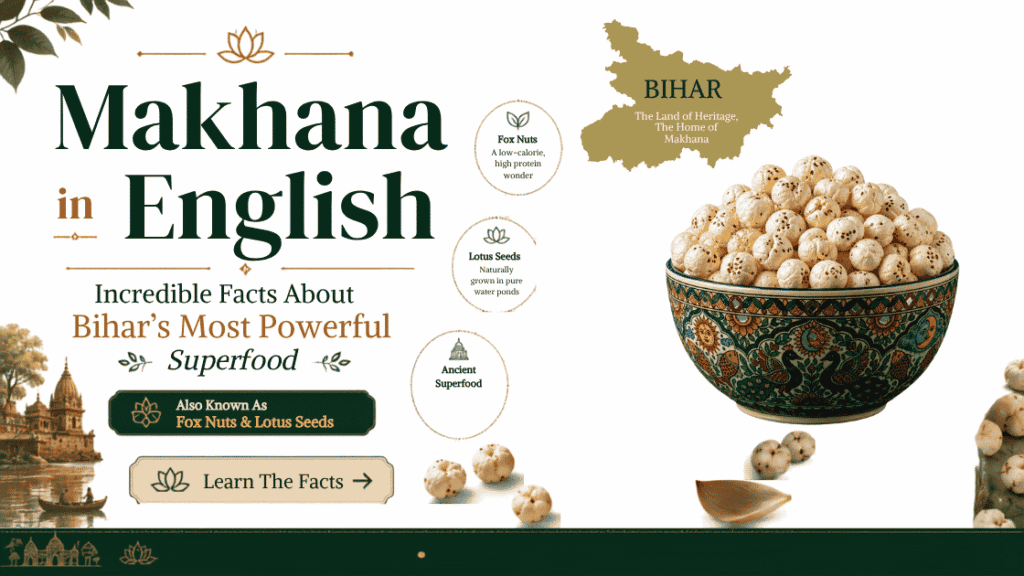
If someone sets down a bowl of white, crispy, puffed seeds and says “have some makhana,” your first question is natural: what is makhana in English? The short answer is fox nuts — but that barely scratches the surface. Makhana, called fox nuts or water lily seeds in English, is one of India’s oldest and most nutritionally extraordinary foods, and it’s currently having a serious moment on the global health food scene.
At Tapua Foods, we source our makhana directly from over 200 farming families in the Mithila region of Bihar — the heartland where makhana has been grown for centuries. In this guide, we’re breaking down everything: the botanical truth, the fascinating history, 7 incredible facts you didn’t know, and how to eat it properly.
Table of Contents
- What Is Makhana in English?
- The Botanical Truth: Is Makhana From the Lotus?
- Where Does Makhana Come From?
- 7 Incredible Facts About Makhana You Didn’t Know
- Makhana Nutrition — A Quick Look
- What Does Makhana Taste Like?
- How to Eat Makhana
- FAQs About Makhana in English
What Is Makhana in English?
Makhana in English is most commonly called fox nuts. Other English names include:
- Water lily seeds — the most botanically accurate term
- Lotus seeds — a common misnomer (more on this below)
- Gorgon nuts — an older colonial-era name, rarely used today
- Euryale ferox seeds — the scientific name, used in academic literature
The name “fox nuts” has murky origins. One theory links it to the plant’s seed dispersal pattern; another traces it to an old English translation of Chinese folk medicine texts where the plant was described in relation to foxes. Whatever the etymology, fox nuts is the term you’ll find most consistently in international food and health contexts.
The Botanical Truth: Is Makhana From the Lotus Plant?
Here’s something that surprises almost everyone: makhana does NOT come from the lotus (Nelumbo nucifera). It comes from Euryale ferox — a different aquatic plant altogether, belonging to the water lily family (Nymphaeaceae).
The confusion is understandable. Both plants grow in similar freshwater habitats, and their seeds look similar to the untrained eye. But Euryale ferox is thornier, with distinctive purple-veined leaves that can grow over a metre across. Its seeds are encased in spiky pods that make harvesting genuinely hazardous.
Knowing this matters if you’re buying makhana online: authentic Mithila Makhana should come from Euryale ferox grown in the wetlands of Bihar — not Chinese lotus seed imports, which are a different product entirely.
For more on authentic sourcing, see our Stories section on the Sacred Story of Bihar’s Black Gold.
Where Does Makhana Come From?
Makhana is deeply rooted in the Mithila region of Bihar, India. Bihar alone produces over 85% of the world’s makhana supply, with the districts of Darbhanga, Madhubani, Saharsa, and Supaul as the primary growing areas.
Makhana received its Geographical Indication (GI) tag in 2022, officially recognising Mithila as its sole authentic origin. Like Champagne from France or Darjeeling tea from West Bengal, genuine Mithila Makhana is a product of a specific place and a specific community.
The communities most involved in makhana cultivation are the Mallah (fisherfolk) families of Bihar — many of whom have passed this knowledge down through generations. At Tapua, every pack is linked via QR code to the specific farming family that grew it.
7 Incredible Facts About Makhana You Didn’t Know
1. Makhana Has Been Eaten for Over 3,000 Years
Makhana’s documented history stretches back to ancient Ayurvedic texts, where it appears under the name Makhana or Mishri Makhana as a food that “nourishes the body, strengthens reproductive health, and promotes longevity.” It was offered as prasad in temples, eaten during fasting, and prescribed by vaidyas (Ayurvedic practitioners) for kidney and digestive health.
2. Harvesting Makhana Is Genuinely Dangerous Work
Farmers harvest makhana seeds by wading — sometimes swimming — into chest-deep, murky ponds. Euryale ferox has thorns not just on its stems but across its leaves and seed pods. Workers spend hours in the water, navigating prickly terrain while collecting seeds from the muddy pond floor. Cuts, skin infections, and foot injuries are occupational hazards.
3. The Popping Process Is 100% Manual and Requires Years of Skill
After drying and roasting, each makhana seed is cracked open individually using a wooden mallet. A skilled worker strikes the seed at precisely the right angle and force, causing the inner kernel to expand and pop — not unlike popcorn. Getting it wrong means a wasted seed. This skill takes years to develop and cannot currently be replicated at scale by machines.
4. Makhana Contains All Essential Amino Acids
Most plant proteins are incomplete, missing one or more essential amino acids. Makhana is a remarkable exception: it contains all essential amino acids including methionine and lysine — often absent in grain and legume proteins. This makes it a genuinely complete plant protein, which is rare in the snack world.
5. It Has a Lower Glycemic Index Than Brown Rice
Makhana’s glycemic index sits between 38 and 42 — lower than brown rice (50), white bread (75), and most fruits. This means blood sugar rises slowly after eating makhana, avoiding the spikes and crashes that follow most carbohydrate-rich snacks.
6. It’s Been an Official Fasting Food for Centuries
Makhana is classified as a “phalahari” or sattvic food in Hindu dietary traditions — meaning it’s pure, light, and permissible during religious fasts including Navratri, Ekadashi, and Shravan. This is one reason makhana consumption spikes sharply during India’s major fasting seasons.
7. Bihar’s Makhana Industry Is Worth Billions — and Growing
According to the Mongabay India investigation (2025), the makhana industry is now valued at over ₹6,000 crore and growing rapidly, driven by health-conscious urban consumers and rising global interest in plant-based snacking. Yet most farmers still earn less than ₹400/day. This is why Tapua’s direct-from-farmer model matters.
Makhana Nutrition — A Quick Look
Per 100g of plain, traditionally processed makhana:
- Calories: ~347 kcal
- Protein: 9.7g (complete protein with all essential amino acids)
- Carbohydrates: 76.9g
- Dietary Fibre: 14.5g
- Fat: 0.1g (essentially fat-free)
- Calcium: 60mg
- Magnesium: 210mg (~50% of daily requirement)
- Iron: 1.4mg
- Glycemic Index: 38–42 (low)
For comparison: 100g of regular potato chips contains over 500 calories, 30g+ of fat, and negligible fibre. Makhana isn’t just a healthier snack — it’s in a fundamentally different nutritional category.
Full nutritional deep-dive: Makhana Nutrition Facts — Ayur Times.
What Does Makhana Taste Like?
Plain makhana has a mild, slightly earthy, almost neutral flavour — not sweet, not salty, not strongly savoury. The real appeal is the texture: light, airy, and satisfyingly crispy. Think of popcorn, but denser and without the kernel.
That neutrality is actually a feature: makhana absorbs flavours beautifully. Toss with ghee and black salt for a savoury snack. Add turmeric and chaat masala for something tangy. Simmer in sweetened saffron milk for makhana kheer. The flavour possibilities are genuinely wide.
How to Eat Makhana
The quickest method: dry-roast a small handful in a heavy pan over low-medium heat for 5–7 minutes, stirring constantly, until they’re crispy all the way through. Add your seasoning of choice. Done.
Beyond roasting, makhana works in:
- Makhana kheer — a rich, festive pudding made with full-fat milk and saffron
- Makhana curry — a vrat staple cooked with yogurt or tomato gravy
- Makhana trail mix — paired with dried fruits and pumpkin seeds
- Makhana raita — lightly crushed into spiced yogurt
Explore step-by-step recipes at tapuafoods.com/recipes.
FAQs About Makhana in English
Is makhana the same as lotus seeds?
No. Makhana comes from Euryale ferox (water lily family), not from the lotus plant (Nelumbo nucifera). The two look similar but are botanically distinct and have different nutritional profiles.
Can makhana be eaten raw?
Technically yes, but it’s unpleasant — hard, chalky, and flavourless. Always roast before eating. Even 5 minutes in a dry pan transforms the texture completely.
Where can I buy authentic Mithila Makhana?
Look for GI-tagged makhana with farm-level traceability. Tapua Foods sources directly from 200+ farming families in Darbhanga, Bihar. Explore options at tapuafoods.com/shop.
Is makhana gluten-free?
Yes. Plain makhana is naturally gluten-free, making it an excellent snack for people with celiac disease or gluten sensitivity. Always check flavoured varieties for additive ingredients.
Bottom line: Makhana in English is fox nuts — a 3,000-year-old superfood from Bihar’s wetlands, hand-harvested and hand-processed by farming communities who have made it their livelihood for generations. Whether you’re eating it for the nutrition, the history, or simply because it’s delicious, knowing where it comes from makes every bowl mean a little more.
Ready to try single-origin, GI-tagged makhana from Tapua? Visit tapuafoods.com/shop and scan the QR code on your pack to meet the farming family who grew it.