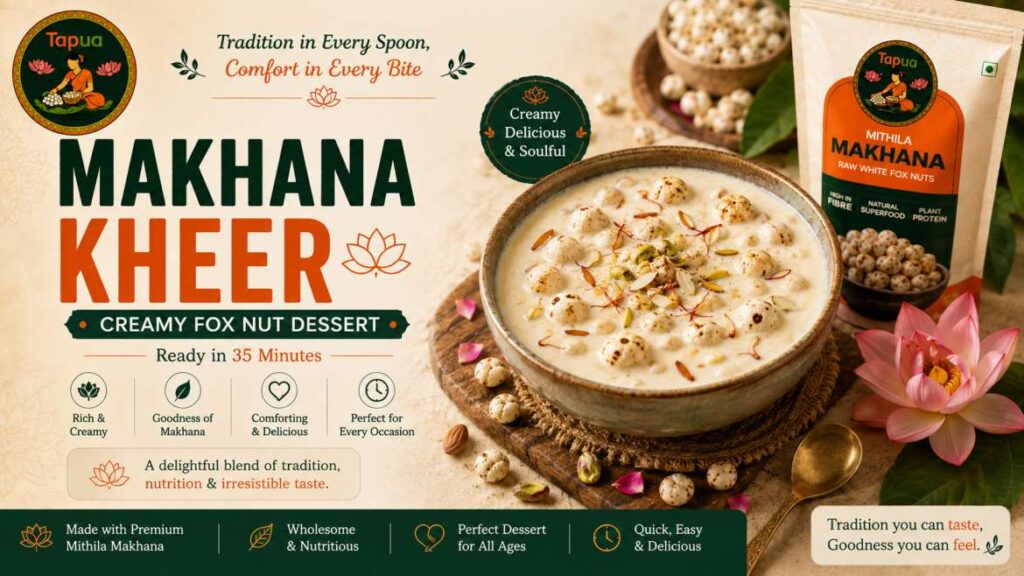
Makhana kheer has more body than rice kheer and comes together faster. The technique is a split: grind two-thirds of the roasted makhana to a fine powder with cardamom and saffron, keep one-third whole. The powder thickens the milk from within; the whole pieces give you something to bite into. Without the split, you get either a thin pudding or a paste — neither is the kheer.
Tapua is a village in Mithila — the name isn’t marketing, it’s the place the makhana comes from. Kheer made with makhana from that region has a mild nuttiness after roasting that carries the saffron and cardamom without competing with either. Ready in 35 minutes, scales without adjustment.
When this kheer gets made
Makhane ki kheer is a Bihar winter dessert in the way rice kheer is everywhere else — expected at festivals, served after the evening puja, offered as prasad during Ekadashi and Navratri. Makhana is one of the few ingredients that is unambiguously vrat-approved without substitution. The saffron and cardamom version is the festival version; plain makhana simmered in milk with sugar is the everyday one.
What You’ll Need
- 1 cup makhana (fox nuts / phool makhana)
- 2 cups whole milk
- 3–4 green cardamom pods, husked and seeds crushed
- 10–12 cashews [or blanched sliced almonds]
- 1 tbsp golden raisins
- 3.5–4 tbsp sugar [or jaggery / rock sugar to taste]
- 1 pinch saffron strands
- 2-3 tsp ghee
Step-by-Step
- Heat the ghee in a wide pan on low heat. Add the makhana and cashews together and roast, stirring often, until the makhana is fully crunchy and cashews are golden — about 8–10 minutes. Don’t rush: the crunch built here determines the texture in the finished kheer.
- Remove to a plate. Set the cashews aside separately — they don’t go into the blender.
- Reserve one-third cup of roasted makhana and set aside. Add the remaining makhana to a blender with the crushed cardamom seeds and saffron strands. Grind to a fine powder — finer gives more body.
Cook’s tip: Grind the makhana while still slightly warm from roasting. Warm makhana grinds to a finer powder than cold. Cold makhana forms coarser bits that don’t dissolve as smoothly into the milk.
- Heat the milk in a heavy-bottomed saucepan on medium-low heat, stirring every minute to prevent scorching. Bring to a full boil.
- Add the sugar and stir to dissolve. Add the makhana powder and the reserved whole pieces. Stir thoroughly — the powder clumps if you stop moving it.
- Reduce to low heat. Simmer for 9–10 minutes, stirring at intervals. Scrape any milk solids from the sides back into the kheer — that’s concentrated flavour, not waste. The kheer will thicken and the whole makhana pieces will soften.
- Add the roasted cashews and raisins. Stir and simmer for one more minute.
- Taste for sweetness. Remove from heat. The kheer thickens further as it cools.
Serving
Warm is best on a cold evening — serve in small bowls with a few extra saffron strands on top. For a dinner party, serve chilled in individual glasses with crushed pistachios. For prasad, serve at room temperature in small quantities. The kheer is rich; a little goes further than you’d expect.
Storing
Refrigerate in a covered container for up to 2 days. It thickens significantly in the fridge — stir in a small splash of warm milk before serving. Don’t freeze; the milk proteins don’t hold up and the texture breaks.
Does the grinding step actually matter?
Yes, significantly. The makhana powder dissolves into the milk and creates the body of the kheer. Without it, you’d need to simmer for much longer to achieve any thickness, and the result would be thinner and less interesting.
Making it for Navratri
Everything in this recipe is vrat-compliant with no modifications. Cashews, raisins, ghee, saffron, cardamom, and sugar are all fasting-approved. Some people use rock sugar (mishri) for a slightly different, less sharp sweetness.
Without sugar
Jaggery powder works well — it adds a faint caramel note alongside the saffron. Add it after simmering, not before, to avoid any curdling. Condensed milk makes the kheer noticeably richer — reduce the quantity accordingly.
Why mine came out too thick
The kheer always thickens as it cools. If too thick after refrigeration, add a small amount of warm milk and stir gently. Making it slightly thinner than you want before taking it off the heat is the better strategy.
Using coconut or almond milk
Coconut milk works — warm it gently, and add the makhana powder after turning the heat off. Don’t simmer for too long or it can separate. The result is lighter and cleaner than full-fat dairy, without the richness.