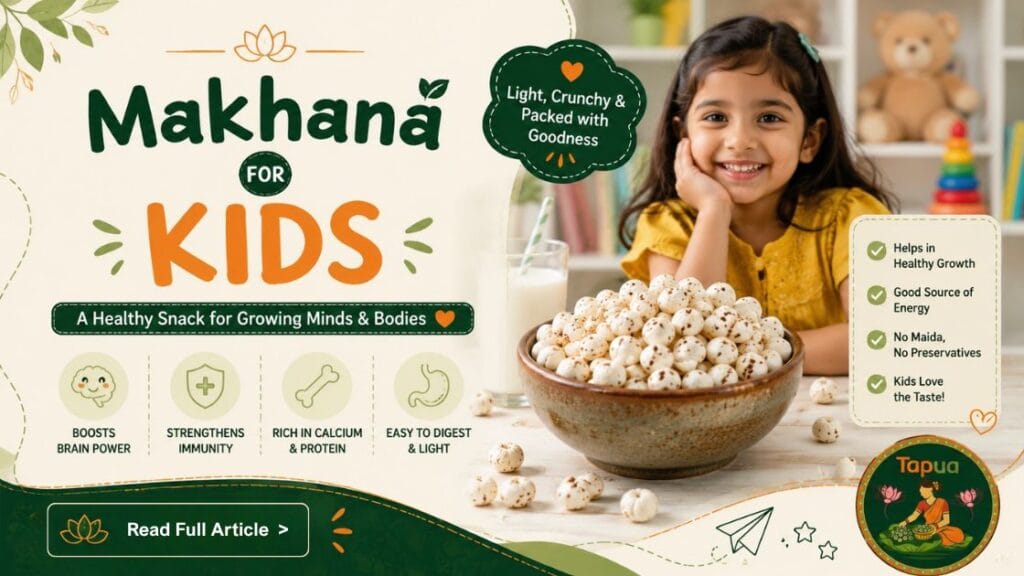
Ask any parent what their biggest everyday nutrition challenge is, and the answer is usually the same: getting kids to eat something actually good for them — something they’ll choose over biscuits, chips, and the brightly-packaged sugar-bombs that line every supermarket checkout counter.
Makhana for kids might be the answer you’ve been overlooking. It’s crunchy, mild, adaptable to dozens of flavours, easy to prepare, and nutritionally exceptional. And — most importantly — many kids genuinely enjoy it once they’ve tried it the right way.
Table of Contents
- Why Makhana Is Ideal for Kids
- 6 Powerful Nutritional Reasons
- At What Age Can Kids Start Eating Makhana?
- Is Makhana Safe for Kids with Allergies?
- 4 Kid-Approved Makhana Recipes
- What to Avoid When Giving Makhana to Children
- FAQs
Why Makhana Is Ideal for Children
The snack challenge for parents isn’t just about nutrition — it’s about the battle between nutritious options and the relentless marketing of processed snacks to children. Makhana for kids works because it doesn’t ask children to compromise on enjoyment. It’s:
- Crunchy and satisfying — the #1 reason kids like snacks
- Mild in flavour — can be seasoned to be anything from salty to sweet to tangy
- Easy and quick to prepare — 7 minutes in a pan
- Naturally allergen-friendly — no gluten, no dairy, no common nuts
- Genuinely nutritious — complete protein, magnesium, fibre, calcium
6 Powerful Reasons Makhana for Kids Is a Nutritional Win
1. Supports Growing Bones — Calcium and Phosphorus
Children’s bones are in active growth throughout childhood and adolescence. The primary nutrients for bone mineralisation — calcium (60mg/100g), phosphorus (200mg/100g), and magnesium (210mg/100g) — are all present meaningfully in makhana.
For children who don’t tolerate dairy well or are simply not big milk drinkers, makhana offers an alternative calcium and mineral source that’s genuinely palatable.
2. Complete Protein for Muscle and Brain Development
With 9.7g protein per 100g and a complete amino acid profile (all essential amino acids present), makhana offers growing children the building blocks for muscle development, tissue repair, enzyme production, and neurotransmitter synthesis.
Brain development in childhood is particularly dependent on adequate protein. Makhana’s complete amino acid profile — unusual for a plant snack — makes it one of the most nutritionally complete non-meat protein snacks for children.
3. Sustained Energy Without Sugar Crashes
Most kids’ snacks are high-GI: they spike blood sugar quickly, produce a burst of energy and alertness, then cause a crash that leads to irritability, difficulty concentrating, and renewed hunger within an hour.
Makhana’s low glycemic index (38–42) produces slow, sustained energy release — the kind that supports concentration at school, physical activity, and mood stability without the cycle of spikes and crashes.
4. Magnesium Supports Healthy Nervous System Function
Magnesium deficiency in children is associated with hyperactivity, anxiety, difficulty sleeping, and muscle cramps. Makhana provides 210mg/100g — an exceptionally high amount. A 20–30g serving delivers roughly 8–10mg of magnesium, contributing to the child’s daily 80–240mg requirement (age-dependent).
5. High Fibre Supports Digestive Health
Constipation and irregular digestion are extremely common in children — often worsened by low-fibre school diets heavy in processed and refined foods. Makhana’s 14.5g fibre/100g is significantly higher than most snack alternatives and supports healthy bowel regularity without the side effects of some laxative-type fibres.
6. No Sugar, No Artificial Additives, No Junk
Plain roasted makhana has one ingredient: makhana. No added sugar, no artificial colours, no flavour enhancers, no preservatives, no seed oils. For parents trying to reduce children’s processed food exposure, makhana is one of the cleanest packaged snacks available — and it still passes the crucial “will my child actually eat it” test.
At What Age Can Kids Start Eating Makhana?
6–12 months: Not recommended in whole form — presents a choking risk. Makhana powder can be incorporated into porridge or dal for babies being weaned onto solids (check with your paediatrician first).
12–18 months: Lightly roasted, small pieces only. Always supervise and ensure pieces are small enough to be safely chewed and swallowed without choking.
2+ years: Full-size roasted makhana is generally safe when the child can chew properly. Supervise young toddlers.
4+ years: Makhana is an excellent independent snack option — tiffin boxes, after-school, bedtime.
If in doubt, consult your paediatrician, especially for children under 2.
Is Makhana Safe for Kids with Allergies?
Makhana is naturally:
- Gluten-free
- Dairy-free
- Nut-free (it is not a tree nut or peanut)
- Soy-free
- Free from common allergens
It belongs to the aquatic plant family (Nymphaeaceae), not to any common allergen group. Children with nut allergies, gluten intolerance, or lactose intolerance can typically eat makhana safely.
If your child has a rare allergy to aquatic plants or seeds, consult a doctor before introducing makhana. As with any new food, introduce in small amounts first and watch for any unusual reaction.
4 Kid-Approved Makhana Recipes
1. Cheese & Herb Makhana (The Tiffin Box Winner)
Roast 50g makhana in a pan for 6 minutes. Remove from heat. Sprinkle immediately with: 1/4 tsp nutritional yeast (or a tiny grating of parmesan), 1/4 tsp mixed dried herbs, 1/4 tsp garlic powder, salt to taste. The heat from the makhana melts the coating slightly. Let cool and pack into an airtight box.
2. Cinnamon & Jaggery Sweet Makhana
Roast 50g makhana in a pan with 1/4 tsp ghee for 6 minutes. Remove from heat. Add 1/2 tsp powdered jaggery and 1/4 tsp cinnamon. Toss quickly — the jaggery melts into a light coating from the heat. Let cool completely before serving (jaggery hardens as it cools). This is the one kids reliably ask for again.
3. Makhana Trail Mix for Tiffin
Combine 30g roasted makhana + 10g raisins + 10g dried cranberries + 10g pumpkin seeds. Store in a small airtight container. Under 170 calories, naturally sweet, no added sugar. Works as a school tiffin, long journey snack, or sports bag staple.
4. Makhana Kheer (Festival & Celebration Special)
See our full recipe in the Makhana Kheer blog post. Kids universally love this one — it’s essentially a richer, nuttier version of rice kheer, and most children who claim not to like makhana will happily eat it in kheer form.
What to Avoid When Giving Makhana to Children
- Heavy oil or butter coating: defeats the nutritional purpose and adds unnecessary calories
- Commercial spiced/chilli makhana: too spicy for most children and often contains unhealthy additives
- Very large portions: 20–30g is enough for a snack; makhana fills kids up quickly due to high fibre
- Giving it whole to very young children: see age guide above; always supervise under age 4
FAQs
How much makhana can a child eat per day?
20–30g (roughly a small fistful) is appropriate for most school-age children as a once-daily snack. This is enough to deliver meaningful nutrition without displacing appetite for main meals.
Can makhana cause constipation in kids?
No — the opposite. Makhana’s high fibre content actively supports bowel regularity. If a child is already consuming adequate fibre from other sources, adding 30g of makhana will not cause constipation.
My child doesn’t like makhana. What should I try first?
Start with the cinnamon-jaggery version (Recipe #2) — the sweetness masks any unfamiliar flavour. Alternatively, try makhana kheer, which most children enjoy immediately. Avoid serving plain, unseasoned makhana to children who are new to it; the mild flavour can seem “boring” without some seasoning.
Makhana for kids isn’t a compromise snack — it’s a genuinely excellent one that many children love once they’ve been introduced to it properly. The nutritional profile makes parents happy; the crunch and flavour versatility keeps kids coming back.
Find Tapua’s single-origin, zero-additive makhana at tapuafoods.com/shop.