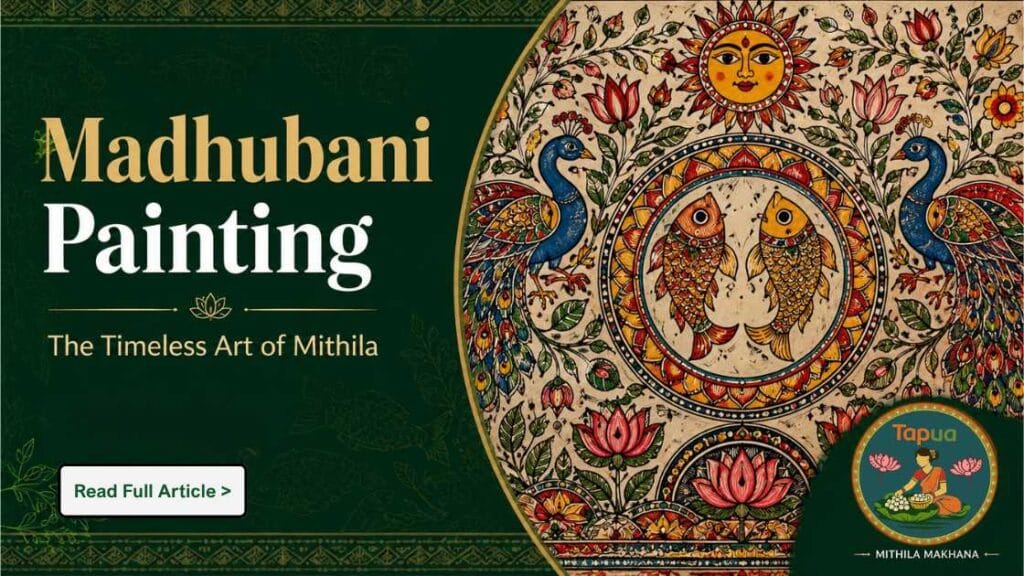
Next time you open a pack of Tapua makhana, take a moment with the illustration on the front. That isn’t generic packaging art. It’s Madhubani painting — one of India’s oldest, most vibrant, and most culturally loaded art traditions, originating from the same Mithila region of Bihar where your makhana was grown and harvested.
Madhubani painting and makhana are inextricably linked by geography and culture. Understanding one deepens your appreciation of the other. This is the full story.
Table of Contents
- What Is Madhubani Painting?
- The 2,500-Year History of Madhubani Art
- The Earthquake That Revealed It to the World
- Styles Within Madhubani Painting
- What Do the Symbols Mean?
- How Madhubani Paintings Are Made
- Recognition and GI Tag
- Madhubani Painting and Tapua Foods
- FAQs
What Is Madhubani Painting?
Madhubani painting (also called Mithila art or Mithila painting) is a traditional folk art form from the Mithila region of Bihar, India — the same region where Tapua’s makhana is grown. The name derives from “Madhubani,” a district in northern Bihar that has been the most active centre of this art’s production and preservation.
Traditionally, Madhubani art was created by women — painted or drawn on the mud-plastered walls and floors of homes, particularly during festivals, marriages, and religious ceremonies. The art was not created for galleries or commerce; it was a living, breathing part of daily domestic and spiritual life.
What makes Madhubani painting immediately recognisable is its visual vocabulary: bold outlines, geometric patterns, bright natural colours, and subjects drawn from Hindu mythology, nature, and daily rural life — lotus flowers, fish, peacocks, elephants, gods and goddesses, scenes from the Ramayana and Mahabharata. Every element carries meaning.
The 2,500-Year History of Madhubani Art
The origins of Madhubani painting are traced back approximately 2,500 years, with the earliest documented reference appearing in the Ramayana itself. According to tradition, King Janak of Mithila — the father of Sita — commissioned paintings to commemorate and capture the moments of his daughter’s wedding to Prince Rama. The painters he employed were the women of his kingdom, creating art that told the story of the divine union for generations to come.
Whether or not this specific origin is historical, it establishes how deep the tradition runs: Madhubani art was practised before written records could track it, passed from mother to daughter as both a skill and a form of prayer.
The Mithila region has a long history as a centre of Sanskrit scholarship, religious tradition, and cultural sophistication. Madhubani painting is part of a broader cultural fabric that includes the Maithili language, Mithila cuisine (of which makhana is a central element), and a rich oral tradition of songs, poetry, and storytelling.
The Earthquake That Revealed It to the World
For most of its history, Madhubani painting existed on mud walls — fragile surfaces that were regularly replastered and repainted, meaning the art was rarely permanent and almost never seen outside the communities that made it.
In 1934, a devastating earthquake struck north Bihar, destroying thousands of homes. When British colonial officer William G. Archer visited the affected areas to assess the damage, he saw something extraordinary: the collapsed walls of homes revealed their interiors, and on those interiors were the most intricate, vivid paintings he had ever encountered.
Archer photographed the paintings extensively and wrote about them in his 1949 essay “Maithil Painting,” introducing them to art historians in Delhi, London, and beyond. This single act of documentation is widely credited with beginning the process that eventually brought Madhubani painting from village walls to international galleries.
According to the World History Encyclopedia’s detailed profile, Madhubani art remained largely unknown outside Bihar until the 20th century, despite being one of the most continuously practiced art traditions in the subcontinent.
Styles Within Madhubani Painting
Madhubani painting is not a single uniform style — it encompasses at least five distinct regional sub-styles, each associated with different communities and visual traditions within the Mithila region:
Bharni Style
Associated with the Brahmin community. Characterised by filled-in, bold colours with minimal empty space. Subject matter focuses on deities — Durga, Krishna, Shiva, Surya. The most immediately colourful and visually intense style.
Kachni Style
Fine line work with hatching patterns filling space instead of solid colours. Associated with the Kayastha community. More intricate and detailed than Bharni; often depicts natural subjects (birds, fish, lotus) with extraordinary precision.
Tantrik Style
Associated with religious Tantric practice. Uses geometric forms, yantras, and specific sacred symbols. More abstract than representational.
Godna Style
Originally inspired by tattoo patterns. Associated with the lower castes of Mithila who were traditionally not permitted to paint deities. Uses geometric patterns, dots, and linear designs derived from the tattoos worn by Mithila women.
Kohbar Style
Wedding art. Created specifically for the bridal chamber (kohbar ghar) as a prayer for fertility and marital happiness. Features lotuses, fish, bamboo, parrots, and the sun and moon — all symbols of prosperity, fertility, and divine blessing.
What Do the Symbols in Madhubani Painting Mean?
Every element in traditional Madhubani art is symbolic:
- Fish: fertility, prosperity, and good fortune. One of the most common Madhubani motifs.
- Lotus: purity, spiritual enlightenment, the divine feminine (associated with Goddess Lakshmi).
- Peacock: love, beauty, and the arrival of the monsoon.
- Sun and Moon: cosmic balance, the divine masculine and feminine.
- Bamboo: growth, resilience, and marital happiness.
- Elephant: wisdom, royal authority, and Lord Ganesha.
- Snake: fertility, protection, and the earth’s energy.
Understanding these symbols makes looking at a piece of Madhubani art a very different experience — you’re not just seeing decoration, you’re reading a visual language.
How Madhubani Paintings Are Made
Traditionally, Madhubani art was made with:
- Natural pigments: lampblack for black, ochre for red-brown, turmeric paste for yellow, indigo for blue, plant extracts for green
- Handmade brushes: twigs, matchsticks, fingers, and cloth-wrapped sticks
- Surfaces: mud-plastered walls, cloth, paper, canvas (in modern practice)
Outlines are drawn first — bold, confident lines that define the composition. The interior is then filled with patterns, hatching, or solid colour. Nothing is left empty: Madhubani art abhors blank space, filling every corner with detail.
Modern Madhubani paintings are most commonly made on handmade paper or cloth using a combination of natural and mineral pigments. The GI tag awarded in 2007 protects the tradition and the geographic identity of Madhubani artwork produced in the Mithila region.
Recognition and UNESCO
Madhubani painting received its Geographical Indication (GI) tag in 2007, officially recognising its origin in the Mithila region of Bihar. UNESCO has acknowledged Madhubani painting as part of humanity’s intangible cultural heritage.
The art form received significant state recognition in 1969 when artist Sita Devi was awarded the Bihar State Award for her paintings — one of the first formal recognitions of Madhubani art by a government body. Since then, artists like Ganga Devi, Baua Devi, and Mahasundari Devi have received the Padma Shri, bringing national attention to Mithila’s living artistic tradition.
Madhubani Painting and Tapua Foods
When Tapua Foods was founded, one of the founding decisions was that every pack of makhana would feature original Madhubani art. This isn’t decorative — it’s intentional storytelling.
Tapua’s makhana comes from the same Mithila villages where Madhubani painting has been made for 2,500 years. The farmers who grow the makhana and the women who paint Madhubani art are often from the same communities — sometimes the same families. Putting Madhubani art on every pack is a way of honouring that complete cultural identity, not just the agricultural product.
Every Tapua pack features a different original Madhubani painting, each one commissioned from a local artist and reproduced with their credit. When you buy Tapua makhana, you’re supporting not just the farming community but the artistic one.
Read more about the story behind the art at tapuafoods.com/stories.
FAQs
Where can I buy authentic Madhubani paintings?
Authentic Madhubani paintings are available from government-certified craft cooperatives in Madhubani district, Bihar; from platforms like the Crafts Council of India; and from individual artists whose work is GI-tagged and certified. Avoid mass-produced prints labelled as “Madhubani” from non-Bihar sources.
Is Madhubani art the same as Warli art?
No. Warli is a distinct tribal art tradition from Maharashtra — simpler, more geometric, made primarily in white on dark backgrounds. Madhubani is from Bihar, more colourful, and uses a richer symbolic vocabulary. Both are Indian folk art traditions, but from entirely different regions and cultural contexts.
Can I learn Madhubani painting?
Yes. Many workshops in Patna, Madhubani, and major Indian cities now teach Madhubani painting. Online courses are also available. Learning even the basics — understanding the symbols and practising the line work — deepens appreciation of authentic pieces significantly.
The next time you see Madhubani art — on a pack of Tapua makhana, on a wall in a museum, or on fabric at a craft fair — you’re seeing 2,500 years of an unbroken tradition. A living language that Mithila’s women have kept alive through earthquakes, colonial disruption, and modernisation — and that belongs to the same land that gives us makhana.
Explore Tapua’s Madhubani-art-adorned makhana at tapuafoods.com/shop.