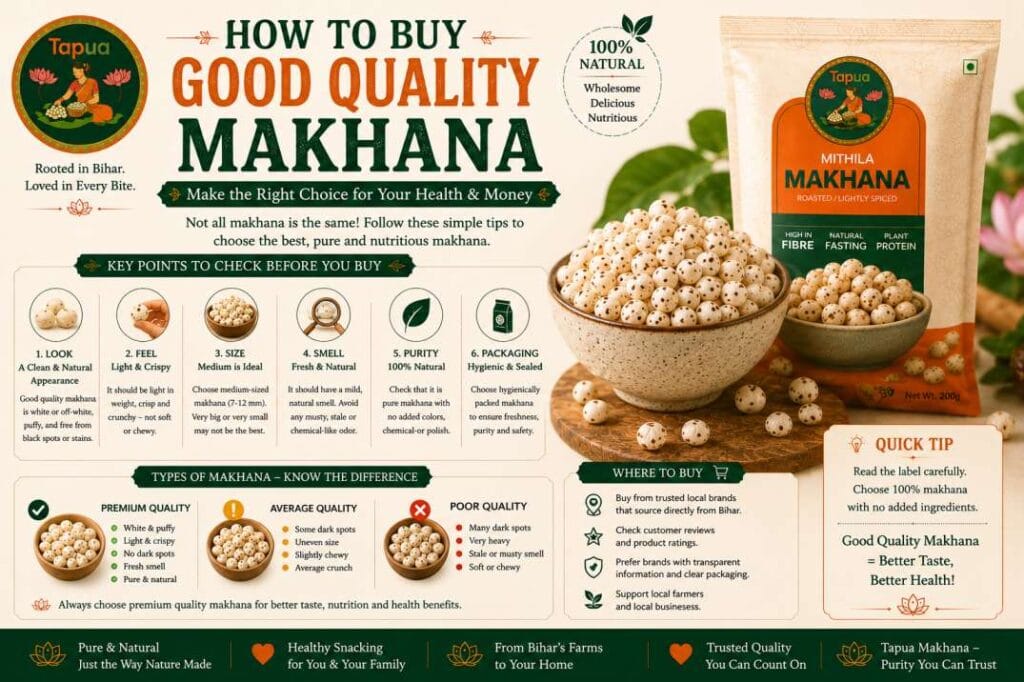
A kilogram of makhana can cost anywhere from about 600 rupees to over 1,800, sitting on the same shelf, sometimes in nearly identical-looking packets. Most buyers have no real way to tell which one is worth the higher number, beyond trusting whatever the label says.
That’s a fair thing to be unsure about, since the differences aren’t always visible at a glance and the grading system behind them, called Suta, isn’t something most packaging explains well. This guide skips the history lesson on what Suta means and goes straight to what you can actually check before you buy: the size and uniformity of the pops, how they sound and feel, what the packaging tells you, and which grade actually suits what you’re planning to cook or serve. None of it requires special equipment. Most of it takes about thirty seconds with a packet in your hand.
What Quality Actually Means for Makhana
Quality in makhana comes down to four things: size, uniformity, dryness, and how cleanly each piece popped. Bigger pops, the higher Suta grades, generally cost more because fewer of them survive the harvest and popping process intact, not because size alone makes them taste better.
Uniformity matters more than people expect. A packet with mixed sizes cooks unevenly, since smaller pieces roast or soften faster than larger ones in the same pan or pot. Dryness affects shelf life and crunch. And a clean pop, meaning the seed has fully opened with no hard, unpopped core left inside, is the difference between a crisp bite and an unpleasant hard centre that catches you off guard.
That post explains how the size grading actually works, if you want the full breakdown. This one is about what to do with that knowledge at the point of buying.
Six Things to Check Before You Buy
Look at the Size and Uniformity First
Tip out a small handful, if the packaging allows it, or zoom into a product photo if you’re buying online. The pops should look roughly the same size throughout, not a mix of tiny broken bits and a few large ones. A bag with mostly broken or chipped pieces is usually a lower grade sold under a vague label, or simply poor handling somewhere between the farm and the shelf.
Listen for the Rattle
Good dry makhana makes a light, hollow rattle when you shake the packet, almost like dry beads. A dull thud or a packet that feels heavier than its size suggests usually means higher moisture content, which shortens shelf life and makes the pops chewy rather than crisp once roasted.
Check the Colour
Properly dried makhana is pearl white to a pale ivory. Pieces that look yellowed, greyish, or have visible dark spots have either aged poorly or were dried unevenly. A small amount of natural colour variation between pieces is normal; consistent discolouration across the batch is not.
Press One Between Your Fingers
If you can get a sample piece, press it gently. It should give a slight resistance before crushing into a light, dry powder, with almost no oily residue. Any greasiness on your fingers afterward suggests the batch was roasted in oil rather than dry-roasted, which changes both the shelf life and the calorie count from what most packaging assumes.
Read the Grade on the Label
Look for an actual Suta number or grade name, 4 Suta, 5 Suta, 6 Suta and so on, rather than vague terms like “premium” or “export quality” with no number attached. A specific grade is something the seller can be held to. A vague descriptor usually isn’t.
Check Where It Was Grown and Sorted
Makhana from the Mithila region of Bihar carries a GI tag, a legal guarantee that it was actually grown there and not relabelled from elsewhere.
That post covers what the tag does and doesn’t promise. Beyond the tag, hand-sorted batches tend to be more uniform than machine-sorted ones, since a person doing the sorting can catch broken pieces, discoloured pieces, and unpopped cores that a mechanical sieve sorting purely by size will miss.
Matching the Grade to What You’re Cooking
Not every dish needs the largest, most expensive pops. A 4 or 5 Suta grade is usually the better economical choice for everyday roasting, chaat, or chopped use in a curry, where the makhana gets broken down or mixed with other textures anyway and size uniformity matters less.
Save the larger 6 Suta and above grades for dishes where the makhana is the visible centrepiece: a kheer where whole pops float in the bowl, a gift box, or a snack you’re serving plain with minimal seasoning, where the bite and size are the entire point.
That post touches on why the larger grades increasingly get reserved for premium and export markets rather than everyday cooking.
Red Flags Worth Skipping
A few signs are worth walking away from rather than working around. Packaging with no grade, harvest, or packing date at all is the biggest one, since it usually means the seller either doesn’t know or doesn’t want to say.
A price noticeably below the going rate for the stated grade is the next, since makhana’s cost is tied closely to genuine labour and yield loss during harvest, and a price that low usually means the grade label doesn’t match what’s actually in the bag. Visible insect activity, a musty smell, or any moisture clinging to the inside of the packaging are straightforward no’s regardless of price or grade.
What Tapua’s Label and QR Code Actually Tell You
Tapua packs are labelled with the Suta grade rather than a vague tier name, and that number reflects an actual hand-sorting process rather than a marketing decision. Every batch passes through people checking size, looking for unpopped cores, and pulling out anything broken or discoloured before it gets packed, which is slower than running everything through a single mechanical sieve but catches more of the things this guide just told you to look for. It’s also why a Tapua bag and a no-name bag of the same stated grade can still feel different in your hand.
Common Questions
Is more expensive makhana always better quality?
Usually, within reason. Price differences mostly track grade size and how carefully a batch was sorted, but past a certain point you’re paying for scarcity of the largest grades rather than a meaningful jump in eating experience. A well-sorted 4 or 5 Suta batch can outperform a poorly handled 6 Suta one.
Does makhana go bad?
It doesn’t spoil the way fresh food does, but it does pick up moisture from the air over time, which makes it chewy instead of crisp and eventually lets mould take hold if it’s stored badly for long enough.
Can I tell the grade just by looking at one piece?
Roughly, yes, once you know what to compare it against. A ruler against the widest point of a few pieces gives you a rough Suta estimate, though sellers should really be telling you the grade rather than leaving you to measure it yourself.
Is loose makhana from a local market as good as packaged makhana?
It can be, and is sometimes cheaper, but you lose the grade label, harvest information, and any GI or sourcing guarantee that packaged makhana from a registered brand carries. Worth it if you trust the seller and can inspect the makhana directly; riskier if you can’t.
Why do two bags labelled the same grade sometimes look different?
Grading isn’t perfectly standardised across every seller, and hand-sorted batches will always have small natural variation since they aren’t machine-uniform. A bag with major inconsistency despite an identical grade label points to inconsistent sorting standards rather than a one-off harvest fluke.
None of this turns buying makhana into a science. It just means you’re no longer guessing between two packets that look identical on a shelf and cost two different prices for reasons you can now actually point to.