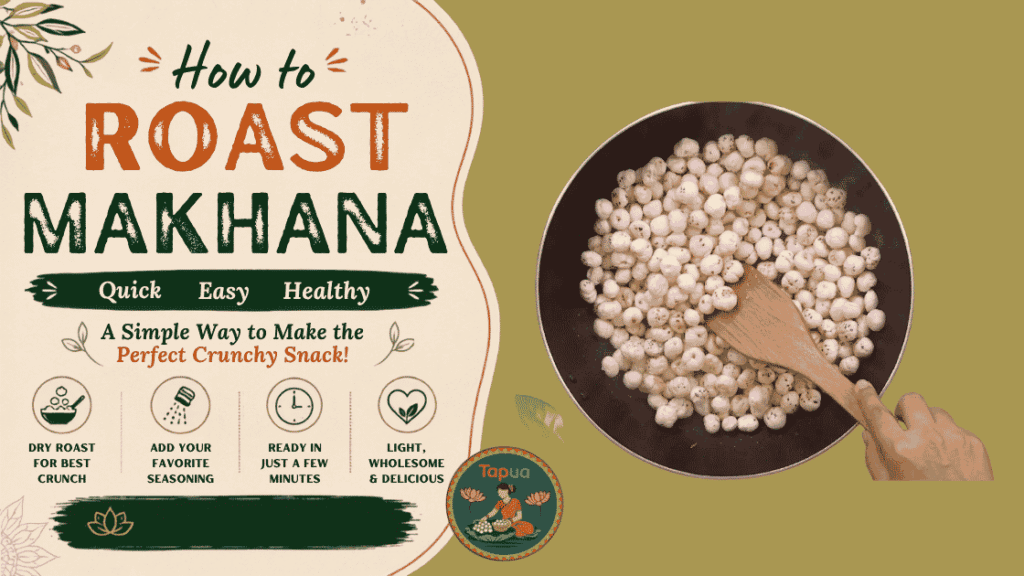
If you’ve ever bought a bag of makhana and found it chewy, soft, or weirdly dense, the culprit was almost certainly the roasting — or the lack of it. Knowing how to roast makhana properly is the single thing that separates a disappointing bowl from the kind of snack people reach for again and again.
The good news: roasting makhana at home is genuinely easy. It takes under 10 minutes and requires no special equipment. The not-so-good news: most guides get the key details wrong. This one won’t.
Table of Contents
- Why Roasting Makhana Matters
- Method 1: Pan Roasting (Traditional & Best Results)
- Method 2: Oven Roasting (Best for Large Batches)
- Method 3: Air Fryer Roasting (Fastest Method)
- 5 Flavour Variations to Try
- How to Store Roasted Makhana
- Common Mistakes to Avoid
- FAQs
Why Roasting Makhana Matters
Raw makhana straight from the pack is already roasted once — the traditional bhoojna process in Bihar. But this initial roast is done for preservation and transport, not for eating pleasure. A second home roast is what produces:
- Maximum crispiness — the texture that makes makhana genuinely snackable
- Fuller, nuttier flavour — heat caramelises the natural starches slightly
- Better seasoning absorption — a properly roasted surface takes spices and salt evenly
- Longer shelf life — re-roasting drives off any residual moisture that may have crept in
If your makhana is soft or chewy, it either wasn’t roasted long enough, was stored in humid conditions, or the original processing was low quality. Tapua’s single-origin, traditionally processed makhana starts from a higher baseline — which means less roasting time needed and a better result.
Method 1: How to Roast Makhana in a Pan (Traditional & Best Results)
This is how makhana has been roasted in Indian homes for centuries, and it’s still the method that gives the best results.
What You’ll Need
- Heavy-bottomed pan or kadai (cast iron or thick stainless steel is ideal)
- Makhana (start with 50–100g to practise)
- 1/2 tsp ghee or cold-pressed coconut oil (optional but recommended)
- Salt and spices of your choice
Step-by-Step Instructions
- Heat your pan over low-medium heat for 1 minute. Do not use high heat — this is the single most common mistake.
- Add the makhana to the dry, ungreased pan. No oil yet.
- Stir or toss continuously. Every 30–45 seconds, move the makhana around the pan to prevent hot spots from scorching individual pieces.
- Continue for 5–7 minutes. You’ll notice the makhana becoming lighter in weight, slightly golden in colour, and it will start to feel noticeably crisper when you press one between your fingers.
- Test one: press it between your thumb and forefinger. It should crack cleanly and feel completely crispy all the way through, with no soft or chewy centre.
- Add ghee (if using) and toss quickly for 30 seconds, then add salt and spices. Season off the heat if possible, to prevent spices from burning.
- Spread on a plate and let cool for 2 minutes before eating. The crispiness intensifies as it cools.
Pro Tip
The biggest mistake people make is using high heat hoping to speed things up. High heat scorches the outside before the inside is fully dry and crisp, leaving you with makhana that’s brown on the surface but still chewy within. Low-medium, patient heat is the only way.
Method 2: How to Roast Makhana in the Oven
If you’re roasting more than 200g at once, the oven is more practical than a pan.
Step-by-Step Instructions
- Preheat oven to 160°C (320°F). Lower than you’d think — makhana burns quickly.
- Spread makhana in a single layer on a baking tray lined with parchment.
- If flavouring with ghee, toss lightly in a bowl before spreading.
- Bake for 12–15 minutes, tossing once at the halfway mark.
- Check at 12 minutes — press one between your fingers to test crispiness.
- Remove, let cool for 3–4 minutes, then season and toss to coat.
Oven Note
Every oven runs differently. The first time you do this, check at 10 minutes and every 2 minutes after. Once your makhana is in the 13-minute sweet spot, you’ll know for next time.
Method 3: How to Roast Makhana in an Air Fryer
The air fryer is the quickest method and produces excellent results with minimal effort.
- Add makhana to the air fryer basket in a single layer. Don’t overcrowd.
- Set to 150–160°C for 6–8 minutes, shaking the basket every 2 minutes.
- Check crispiness at 6 minutes. Air fryers vary significantly in temperature accuracy.
- Season immediately after removing.
The air fryer works well for small batches (50–80g). For more than that, do multiple rounds rather than stacking makhana — overlapping pieces roast unevenly.
5 Flavour Variations to Try
1. Classic Ghee & Rock Salt (The Original)
1/2 tsp ghee + 1/4 tsp sendha namak (rock salt) + 1/4 tsp black pepper. Simple, clean, and the most popular version in Bihar.
2. Turmeric & Cumin (Golden Makhana)
1/2 tsp ghee + 1/4 tsp turmeric + 1/2 tsp cumin powder + salt to taste. Anti-inflammatory, warm, and slightly earthy.
3. Chaat Masala & Lime
Dry roast with no oil. Once crisp, sprinkle 1/2 tsp chaat masala and a squeeze of lime. Tangy and snackable.
4. Cinnamon & Jaggery (Sweet Makhana)
1/2 tsp ghee + 1 tsp powdered jaggery + 1/4 tsp cinnamon. Add jaggery off the heat to prevent burning. Great as a guilt-free sweet snack.
5. Peri Peri (Bold & Spicy)
1/2 tsp ghee + 1/2 tsp peri peri spice mix + 1/4 tsp smoked paprika + salt. For anyone who wants their makhana with some attitude.
Discover more recipe ideas in our Recipes section.
How to Store Roasted Makhana
Roasted makhana loses its crunch when exposed to air and moisture. For maximum shelf life:
- Store in an airtight container at room temperature
- Consume within 3–5 days for peak crispiness
- Do not refrigerate — fridge humidity softens makhana rapidly
- If it softens, re-roast for 3–4 minutes in a pan to restore crispiness
Unroasted makhana from Tapua can be stored for up to 6 months in its original sealed packaging.
Common Makhana Roasting Mistakes
- Using high heat — results in scorched exterior with chewy interior. Always use low-medium heat.
- Not stirring — makhana sits in hot spots and burns unevenly. Stir or toss every 30–45 seconds.
- Adding oil at the start — oil should go in after initial dry roasting, not at the beginning.
- Seasoning while still hot in the pan — spices burn on residual heat. Season off the flame or after a brief cool.
- Skipping the press test — visual colour change isn’t reliable. Always press-test for crispiness.
FAQs
Can I roast makhana without ghee or oil?
Absolutely. Plain dry-roasted makhana is perfectly crispy and delicious. Oil or ghee simply helps spices adhere and adds flavour depth — it’s not necessary for the roasting itself.
How long does roasted makhana stay crispy?
In an airtight container, 3–5 days. In an open bowl on your counter, crispiness starts to fade within 1–2 days in normal humidity conditions.
Can I roast makhana that’s gone soft?
Yes. Soft makhana is almost always just moisture-affected, not spoiled. A 3–5 minute re-roast in a dry pan at low-medium heat fully restores the crunch.
What is the best makhana to use for roasting?
Large, uniform “sutta” grade makhana roasts most evenly and produces the best texture. Tapua’s makhana is hand-sorted to this grade before packaging. See options at tapuafoods.com/shop.
Roasting makhana is one of those skills that takes 10 minutes to learn and then becomes second nature forever. Once you know how to do it properly — low heat, continuous stirring, press test before seasoning — you’ll find yourself batch-roasting every Sunday for the week ahead.