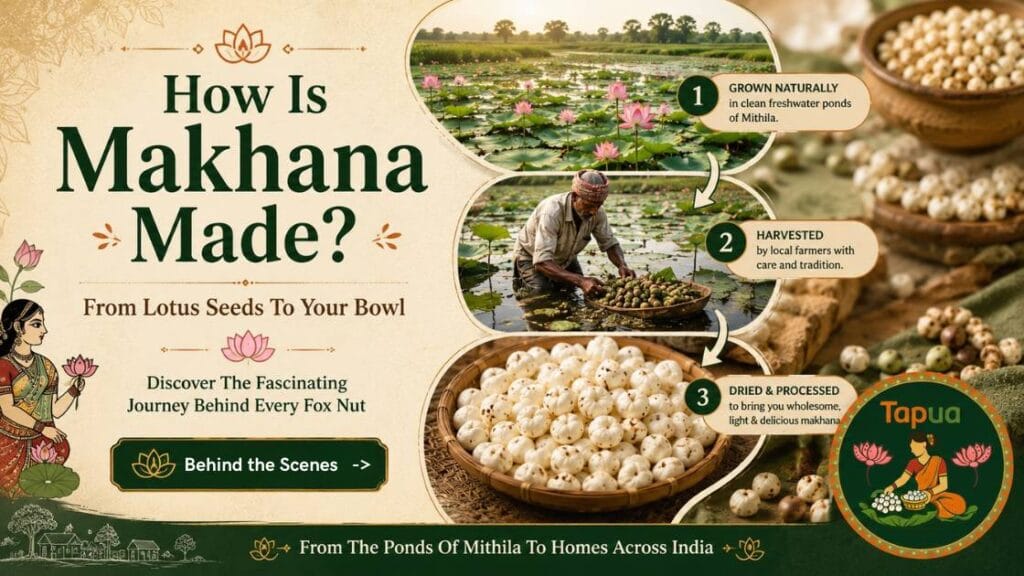
How is makhana made? It’s one of those questions that sounds simple until you look into it — and then the answer humbles you completely. Every bowl of crispy, white makhana (fox nuts) you’ve eaten began in a chest-deep muddy pond in Bihar, harvested by hand by farmers who’ve been doing this for generations. The process from seed to snack is labour-intensive, precision-dependent, and almost entirely manual — which is why truly authentic, traceable makhana is worth understanding.
At Tapua Foods, we work directly with over 200 farming families in the Mithila region of Darbhanga and Madhubani, Bihar. This is our account of exactly how makhana is made — the version most snack brands don’t bother telling you.
Table of Contents
- What Plant Does Makhana Come From?
- Step 1: Growing Makhana in the Ponds
- Step 2: Dangerous Underwater Harvesting
- Step 3: Sun-Drying the Seeds
- Step 4: Roasting in Iron Pans
- Step 5: Hand-Popping — Where the Magic Happens
- Step 6 (Bonus): Sorting, Grading and Packaging
- The Tapua Difference: Farm-to-Table Traceability
- FAQs
What Plant Does Makhana Come From?
Makhana comes from Euryale ferox — a thorny aquatic plant in the water lily family (Nymphaeaceae). This is different from the lotus plant (Nelumbo nucifera), a common and persistent misconception.
Euryale ferox grows in shallow freshwater ponds and wetlands. Its leaves can span over a metre across, with a distinctive purple-veined underside. The plant is armed with sharp thorns on its stems, leaves, and even its seed pods — a reminder that makhana isn’t a gentle crop to work with.
The seeds form inside spiked pods on the pond floor. When mature, they’re a deep reddish-brown to black colour — earning makhana its nickname, “Black Gold of Bihar.” The white, puffed version you recognise is the result of everything that follows.
Step 1: Growing Makhana in the Ponds
Makhana cultivation begins in early spring when farmers sow seeds in shallow ponds or seasonal wetlands. The plants are left largely to grow on their own — Euryale ferox is hardy and requires little intervention during growth.
The ponds used for makhana cultivation are typically 1–3 feet deep and spread across several acres. The same ponds often support fish farming simultaneously, creating a low-cost, high-efficiency dual-use system that many farming families in Bihar have practised for generations.
Bihar accounts for over 85% of the world’s makhana production, with the Mithila region — particularly Darbhanga and Madhubani districts — at its heart. Mithila Makhana received a Geographical Indication (GI) tag in 2022, protecting its regional identity and the communities who produce it.
Step 2: Dangerous Underwater Harvesting
This is where makhana production diverges sharply from any modern food fantasy. Harvesting makhana is one of the most physically demanding and genuinely hazardous agricultural tasks in India.
From late summer through autumn, farmers wade or swim into the ponds to collect the ripe seeds. The water can be chest-deep in some areas, murky, and filled with the thorny stems and leaves of the Euryale ferox plant. Farmers work barefoot, using their feet to feel for the seed pods on the muddy bottom, and their hands (often wrapped in cloth) to collect them.
A single skilled farmer can collect 30–50kg of raw seeds on a productive day. But the physical toll is significant: cuts from thorns, skin infections from murky water, and musculoskeletal strain from hours of stooped, underwater work are common occupational hazards.
According to reporting by Mongabay India (2025), despite makhana being a billion-dollar industry, most farmers still earn under ₹400 per day for this labour. One reason Tapua operates on a direct-from-farmer model is to ensure more of the premium price flows back to the people doing this work.
Step 3: Sun-Drying the Seeds
Freshly harvested makhana seeds are thoroughly washed to remove mud, then spread out on large flat surfaces — typically concrete floors or drying mats — to sun-dry for several days.
This drying stage is critical. The seeds contain significant moisture when harvested. If they’re roasted while still wet, the outer shell softens unevenly and the popping yield drops sharply. Proper drying takes 3–7 days depending on weather and humidity.
Some modern producers use mechanical dryers to speed up this step, but traditional processors — and Tapua’s partner farmers — prefer sun-drying for the consistency it produces. The seeds need to reach a very specific moisture level before the next step works correctly.
Step 4: Roasting in Iron Pans
Once fully dried, the seeds are roasted in heavy cast-iron pans over wood-fire or traditional chulhas. The seeds are stirred continuously as they heat, a process that takes 15–25 minutes depending on batch size and fire intensity.
This roasting step serves two purposes:
- It hardening the outer shell of the seed, creating the structural tension needed for popping
- It reduces any remaining moisture to a precise level that makes the inner kernel explode cleanly when struck
The temperature and timing of this roasting step is entirely experiential — learned through years of practice. Too little heat, and the seeds won’t pop properly. Too much, and they scorch and crack instead of popping.
Step 5: Hand-Popping — Where the Magic Happens
This is the step that defines makhana and cannot currently be replicated at industrial scale by any machine. Each roasted seed is placed on a hard surface and struck with a wooden mallet at exactly the right angle and with exactly the right force.
When done correctly, the outer shell cracks open and the inner kernel — heated under pressure — pops and expands outward, transforming from a dark, dense seed into the white, airy, round makhana you recognise. The change is dramatic: the kernel’s volume increases roughly 3–4 times.
An experienced popper can process several kilograms of seeds per hour, but accuracy is everything. A misaligned strike results in a crushed, wasted seed. Learning this skill to a commercial standard takes 3–5 years of dedicated practice. Most poppers are women, and this knowledge passes through families.
The Mithila Naturals blog and Makhanahub.in both document this process in detail if you want to explore further.
Step 6 (Bonus): Sorting, Grading, and Packaging
After popping, makhana is sorted by size and quality. Standard grades range from “large sutta” (full-round, uniform kernels — the premium grade) down to smaller, irregular pieces used in grinding or cooking. Tapua sources only the top two quality grades.
At this stage, any remaining shell fragments, undersized pieces, or discoloured kernels are removed by hand. The sorted makhana is then lightly roasted one more time (the “bhoojna” step in Bihar’s traditional processing) to enhance crunchiness and extend shelf life — without any added oils.
Finally, the makhana is weighed, packed in moisture-resistant packaging, and — at Tapua — linked to a QR code that tracks it back to the specific farming family and harvest batch.
The Tapua Difference: Farm-to-Table Traceability
Most makhana sold in India changes hands 3–5 times between farmer and consumer. At each step, margin is extracted, quality can degrade, and the story of who grew it is lost.
Tapua Foods works directly with 200+ Mallah farming families in the Mithila region, buying at fair prices, skipping middlemen, and linking every batch to a scannable QR code on the packaging. When you buy Tapua makhana, you can literally scan the pack and see the farming family who grew it.
This isn’t just marketing. It’s the supply chain that makes authentic makhana — the kind where you can verify the GI tag, the grade, and the sourcing — actually possible.
Explore our farm-to-table story at tapuafoods.com/stories.
FAQs
Is makhana made from lotus seeds?
No. Makhana comes from Euryale ferox (water lily family), not the lotus plant. This is one of the most common misconceptions about makhana, including in many food publications.
Why is makhana so expensive if Bihar grows most of the world’s supply?
Because the process is almost entirely manual. Harvesting requires dangerous pond work; popping requires skilled, precision hand-work that cannot yet be mechanised at scale. Each kilogram of finished makhana represents hours of physical labour. The real question is why it’s priced as affordably as it is.
How is makhana popped — does it use oil?
No. Authentic makhana is popped using only heat and the precision strike of a wooden mallet — no oil, no butter, no additives. The “popping” is purely a result of internal pressure from the roasted kernel expanding.
Understanding how makhana is made changes how you eat it. Every bowl represents hours of pond work, careful drying, skilled roasting, and precision hand-popping by farming families in Bihar who have kept this tradition alive for generations.
Buy the real thing — traceable, GI-tagged, direct-from-farmer — at tapuafoods.com/shop.