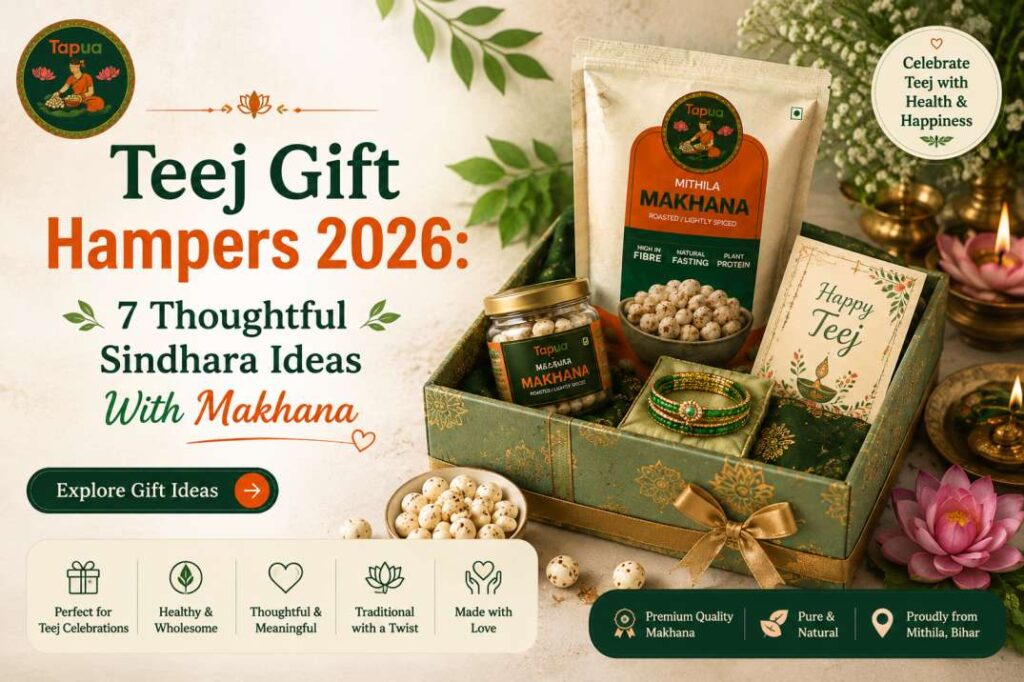
Hariyali Teej falls on Saturday, 15 August 2026, which this year also happens to be India’s Independence Day, giving the festival an unusual double significance. For families who send Sindhara, the basket of gifts parents traditionally send their married daughters before the festival, that date is already on the calendar.
This goes through what Sindhara actually is, what usually goes into the basket, and where a well-chosen makhana hamper fits into that tradition without trying to replace the sweets and bangles that have always been part of it.
What Sindhara Actually Means
Sindhara, sometimes spelled Sinjara, is the basket of gifts a woman’s parents send to her marital home ahead of Hariyali Teej, carrying sweets, new clothes, bangles, mehndi, and other adornments.
The word traces back to the Sanskrit “sringar,” meaning adornment, and the gesture itself is straightforward: a way for parents to stay close to a married daughter through a festival that is, at its root, about married women observing a vow for their husband’s wellbeing. It’s also called Sindhara Teej specifically because of this practice, in states across North India including Bihar, Rajasthan, and Uttar Pradesh.
What Goes Into a Traditional Basket
A typical Sindhara basket centres on ghevar and other festival sweets, along with bangles, bindis, mehndi cones, and often a new saree or set of clothes. None of that is going anywhere, and a makhana hamper isn’t meant to replace it.
What it can do is sit alongside the sweets as something that lasts longer than a day, travels well if the basket needs to go some distance, and gives a health-conscious daughter or mother-in-law something to actually keep eating after the festival sweets run out.
Why Makhana Fits a Festival Gift Basket Particularly Well
Makhana already has a place in fasting and festival food across Bihar, and it travels far better than most sweets: a sealed pack of roasted or flavoured makhana holds its crunch for weeks without refrigeration, which matters if the Sindhara basket is being sent any real distance, by courier or carried on a train, rather than handed over in person.
We worked through a similar pairing for Raksha Bandhan hampers earlier this year, and the same logic carries over to Teej: a festival basket built mostly around things that don’t keep can still use one item that does.
Building a Hamper Around Tapua Makhana
Tapua’s makhana comes from a village of the same name in Mithila, the same region most Sindhara traditions trace back to, which makes it a fitting addition to a basket that is already rooted in regional, family-specific custom rather than anything generic. A simple hamper might pair a 500g or 1kg pack of Tapua’s premium 5-Suta makhana with the usual mithai and bangles, giving the basket one item that isn’t eaten within the week.
For a daughter living far from home, in a different city or country, a hamper built around a longer-lasting item like this also solves a practical problem: festival sweets travel badly, and a pack of makhana doesn’t.
A Few Practical Hamper Ideas
- A mid-size makhana pack alongside a small box of ghevar and a set of bangles, for a simple, traditional basket.
- A larger 1kg pack with a new saree and mehndi cones, for a more substantial gift.
- A smaller 100g pack added to an existing family basket as a single extra item, for anyone who wants to introduce it without changing the basket’s usual contents.
- A flavoured or roasted variety paired with dry fruits, for a basket leaning toward a health-conscious recipient.
Questions People Ask
When is Hariyali Teej in 2026?
Hariyali Teej falls on Saturday, 15 August 2026, the Shukla Tritiya of Shravana, which this year coincides with India’s Independence Day.
What is Sindhara in Teej?
Sindhara is the basket of gifts, typically sweets, clothes, and bangles, that a married woman’s parents send to her marital home ahead of Hariyali Teej.
Is makhana an appropriate Teej gift?
Yes. Makhana already has a place in Bihar’s festival and fasting food traditions, and it travels well compared to sweets, making it a practical addition to a Sindhara basket rather than an unusual one.
Can Sindhara be sent by courier instead of given in person?
Yes, this is common for families living apart, and longer-lasting items like packaged makhana or dry sweets tend to travel better than fresh mithai for this purpose.
What is the difference between Hariyali Teej and Hartalika Teej?
Hariyali Teej falls in the monsoon month of Shravana and is associated with Sindhara gifts from a woman’s parents, while Hartalika Teej falls later, around August or September, and is observed with a stricter fast.
Sindhara has never really been about any one item in the basket. It’s about a family staying connected through a festival built around distance and devotion, and a pack of makhana from a real village in Mithila is, in its own small way, just one more thing carrying that connection along.
Leave a Reply