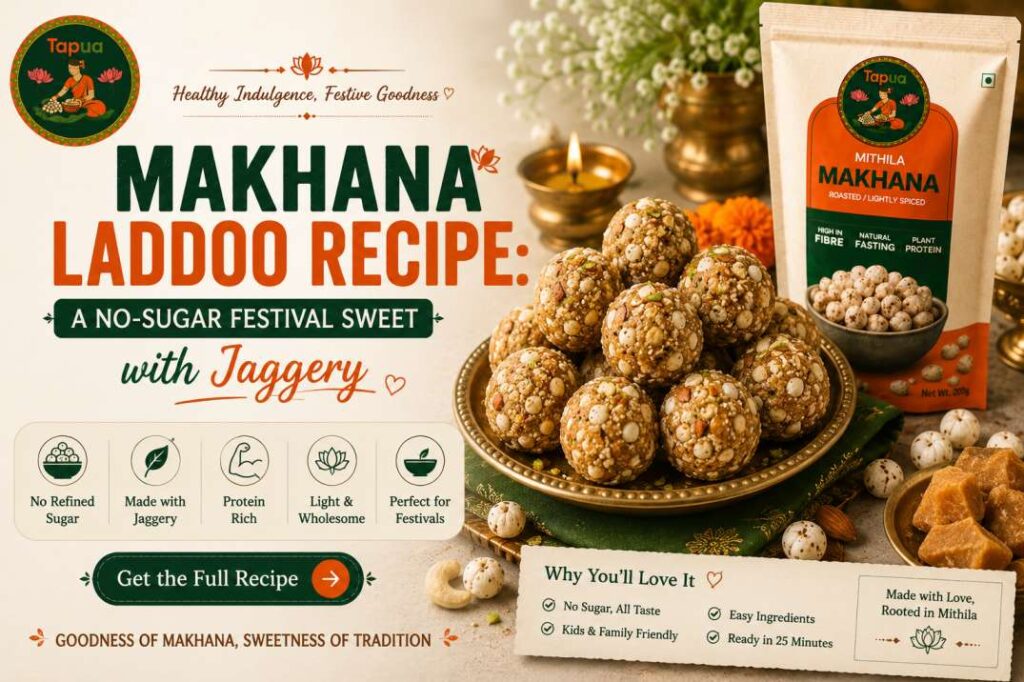
Most laddoo recipes lean on white sugar syrup for binding and sweetness both. This one uses jaggery instead, the way laddoo were made before refined sugar became the default, and it changes the flavour more than you would expect: a deeper, slightly smoky sweetness instead of a flat sugary one. Roasted makhana, almonds, cashews, coconut, and a handful of other nuts and seeds get bound together in warm jaggery syrup and shaped into ladoo while everything is still soft enough to roll.
Fifteen ladoo come out of one batch, at roughly 223 calories each if that is something you track, and they keep for about two weeks in an airtight container, well past most festival gatherings.
This makhana laddoo recipe covers why makhana earns a place in a mostly-nut sweet, why a jaggery version like this one has a real place in festival cooking, the full method including the one step that decides whether your batch turns out soft or rock hard, and how to store whatever does not get eaten in the first sitting.
Why Makhana Works in This Laddoo
Tapua makhana brings bulk and a faint crunch to a laddoo that would otherwise be all nut and very little else. On its own it tastes mild, almost blank, which means it takes on the roasted, slightly smoky flavour of the jaggery syrup completely rather than fighting it the way a more strongly flavoured ingredient might.
It also keeps the laddoo lighter than an all-nut version would be. A laddoo made purely from almonds, cashews, and ghee gets dense fast. Makhana cuts that density without diluting the flavour, since it is mostly air once roasted, the same quality that makes it pop and snap in a hot pan.
A Festival Sweet, Minus the Refined Sugar
Laddoo show up at nearly every Bihari festival and family gathering, and a jaggery-based version like this one has likely been made in Mithila kitchens for longer than the sugar-syrup version most people know today. It travels well, keeps for weeks, and gives you something to send home with guests, which is reason enough on its own for most households to make a large batch rather than a small one.
If you are making this for a specific fasting day, check the customs you follow around jaggery and nuts first, since rules vary by region and by which fast is being observed. As a general festive sweet outside of fasting, it needs no adjustment at all.
What You’ll Need
- 100g Tapua phool makhana
- ½ cup almonds
- ½ cup cashews
- 1 cup desiccated coconut
- 4 tbsp ghee, divided
- 2 tbsp cashews, chopped
- 2 tbsp almonds, chopped
- 2 tbsp pistachios, chopped
- 2 tbsp raisins
- 2 tbsp sesame seeds
- ½ tsp cardamom powder
- 1½ cups jaggery, grated or chopped (or substitute an equal quantity of sugar; the flavour will be lighter and less smoky)
- ½ cup water
Making the Laddoo
- Dry roast the makhana in a kadai over low heat until crunchy and a shade darker. Cool completely, then grind to a fine powder. Set aside.
- In the same pan, roast the almonds and cashews until fragrant and a little darker. Cool, then grind to a fine powder, and add it to the makhana powder.
- Roast the desiccated coconut in the same pan until just turning pale gold, taking care not to let it brown too far. Add it to the same bowl.
- Heat 2 tbsp of the ghee in the pan. Add the chopped cashews, chopped almonds, chopped pistachios, and raisins, and roast until the nuts turn golden and the raisins puff slightly.
- Add this to the same bowl, along with the sesame seeds and cardamom powder. Mix everything together.
- In a large, heavy kadai, combine the remaining 2 tbsp ghee, the jaggery, and the water. Heat gently, stirring until the jaggery dissolves completely.
- Keep cooking the syrup until it reaches one-string consistency. A small drop pressed and pulled between two fingers should stretch into a single thin thread rather than breaking apart or running thin and watery.
Cook’s tip: Test the jaggery syrup the moment it looks ready, not after. Drop a small bit into a cup of water; it should set into a soft, pliable ball you can press between your fingers. Past that point the syrup hardens fast, and the laddoo mixture turns too stiff to roll.
- Lower the flame and add the makhana-nut mixture straight into the syrup. Mix quickly and thoroughly so everything gets coated before the jaggery starts to set.
- While the mixture is still warm and pliable, take small portions and roll them into round ladoo. Work quickly, since jaggery firms up as it cools and the mixture gets harder to shape with each passing minute.
Serving and Storing Makhana Laddoo
Serve at room temperature, ideally the same day or the next, when the texture is at its best: soft enough to bite through easily but still holding its shape completely. They pair well with chai and do not need anything else alongside them.
Store in an airtight container at room temperature, away from direct sunlight, and they keep well for about two weeks. Refrigeration is not necessary and can make the jaggery turn slightly harder than it should be, so a sealed container at room temperature is the better choice here.
If You’re Wondering
Can I use sugar instead of jaggery?
Yes, though the flavour and colour both change. White sugar gives a lighter coloured, more straightforwardly sweet laddoo, while jaggery brings the deeper, slightly mineral sweetness this recipe is built around. If you swap in sugar, use a similar quantity and cook the syrup to the same one-string stage.
Why did my laddoo turn out too hard?
The jaggery syrup was likely cooked past one-string consistency before the dry mixture went in. Once jaggery passes that stage, it hardens quickly and does not stay pliable long enough to shape into smooth, soft ladoo.
Can I skip any of the nuts?
Yes, the ratios here are flexible. If you are missing pistachios, or leaving out one type of nut for an allergy, increase another nut by the same amount and the laddoo will still hold together fine.
How long do these actually stay fresh?
About two weeks in a sealed, airtight container kept at room temperature. Past that, they do not necessarily spoil, but the texture starts to dry out and the laddoo lose some of their softness.
Tapua is named after an actual village in Mithila, not an invented brand word, and there is something fitting about a sweet this rooted in festival tradition carrying that name. Make the full batch. Laddoo rarely survive long enough in a house to need a second one.
Leave a Reply