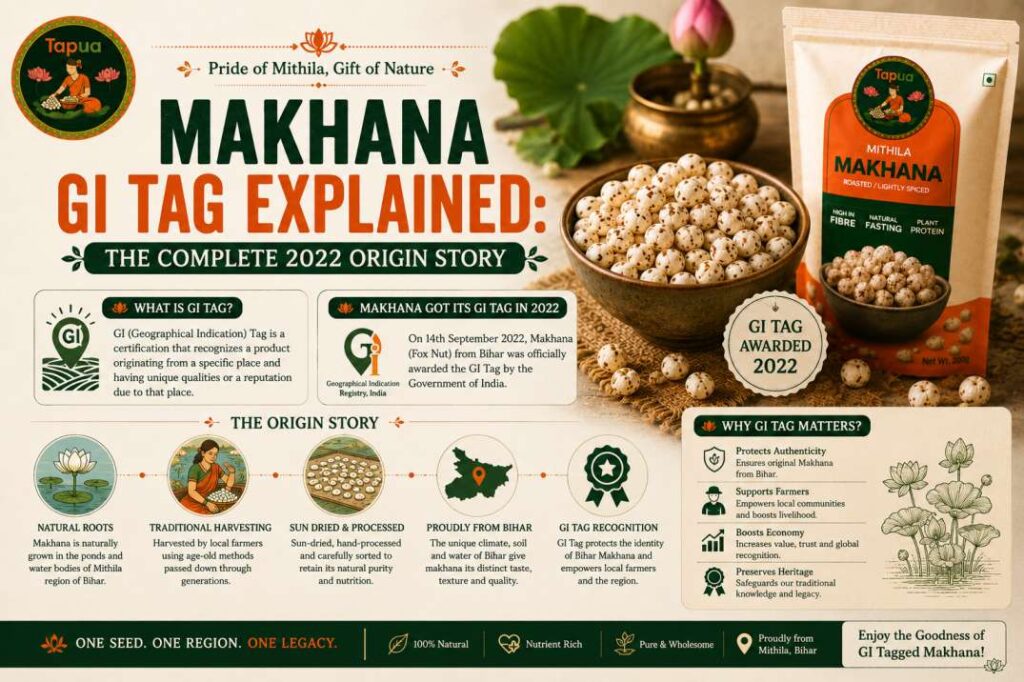
A “GI tag” sounds like packaging jargon until you realise it’s the same legal status that lets Darjeeling tea, Champagne, and the Banarasi saree each claim a name that no one outside their region is allowed to print on a label. Makhana earned that protection in 2022, and the story behind it explains a lot about who actually grows the fox nuts sitting in your snack bowl.
This post lays out exactly when the tag was certified, who applied for it, which districts it covers, and what it does and doesn’t guarantee about quality. If you’ve ever wondered whether “GI tag” on a packet of makhana is a real legal status or just a sticker, this answers it with the actual registration trail.
What a Geographical Indication Tag Actually Protects
A GI tag is a legal recognition that a product’s name is tied to a specific place, and that the place gives the product a quality or character nothing else can replicate. Champagne can only be called Champagne if it’s made in that French region using the traditional method. Darjeeling tea works the same way, and so does the Banarasi saree woven in and around Varanasi. The tag doesn’t rate the product. It protects the name.
For makhana, that means producers outside the registered Bihar districts technically cannot label their fox nuts “Mithila Makhana,” even if the seeds look identical on a shelf. Whether that rule gets enforced in every corner shop is a separate question, but the legal protection itself is real and registered with the Indian government. (If you’re still working out what makhana actually is in English, see our explainer: .)
How Mithila Makhana Got Its GI Tag
Mithila Makhana received GI certification from the Geographical Indications Registry in April 2022, becoming the first makhana variety in India to hold the status. The certificate was formally registered to the Mithilanchal Makhana Utpadak Sangh, a producer association based in Purnia, Bihar, which had filed and pursued the application on behalf of the region’s growers.
The announcement reached a wider audience a few months later, on 20 August 2022, when Union Minister Piyush Goyal publicly highlighted it alongside several other newly tagged Bihar products. Mithila Makhana became the fifth product from Bihar to receive GI status, joining a list that already included Bihar’s Shahi Litchi and Katarni rice.
Which Districts Are Actually Covered
The GI registration covers makhana grown across a defined set of Bihar districts: Darbhanga, Madhubani, Muzaffarpur, Champaran (East and West), Begusarai, Purnea, and Katihar. These are the wetland-pond districts of the Mithila region where Euryale ferox has been cultivated for generations, and where the bulk of India’s makhana actually comes from.
Why the Tag Matters More for the Farmers Than the Label
Bihar, and the Mithila belt specifically, is estimated to grow somewhere around 80 to 90 percent of India’s makhana, depending on the season and source you check. Most of that cultivation still happens the way it always has: families wading into shallow ponds to harvest the seed pods by hand, a task that has historically gone underpaid relative to the price the popped, packaged product fetches once it reaches a city shelf.
A GI tag doesn’t close that gap by itself, but it gives growers and their associations a legal hook to push back on outside producers who’d otherwise borrow the Mithila name without sourcing from the region at all. Tapua sources its makhana from farming families within this same Mithila belt, which is less a marketing detail than a description of where the harvest actually happens.
The harvest itself is genuinely hard, seasonal work. Pods are gathered from pond beds by hand, often standing in waist-deep water, before the seeds are dried, roasted, and popped through a multi-step process passed down within families rather than taught in a factory training manual. A GI tag doesn’t change the physical labour involved, but it does give the association representing these families a recognised legal identity to negotiate with buyers, government bodies, and exporters as a collective rather than as scattered individual growers.
Cooperative-style associations like the Mithilanchal Makhana Utpadak Sangh exist precisely because individual harvesting families have limited bargaining power on their own. A unified group holding a registered GI tag has more standing to negotiate fairer prices with bulk buyers, approach state agricultural schemes for support, and represent the region’s interests when trade policy or export rules are being discussed at a level no single farming household could realistically participate in.
What the Tag Does, and Doesn’t, Guarantee
It’s worth being precise about what a GI tag actually certifies, because the claims sometimes get inflated in marketing copy. It does not certify that the makhana is organic. It does not certify a specific size, grade, or pesticide-free growing process. It also doesn’t, by itself, guarantee freshness or how the product was handled after harvest.
What it does guarantee is narrower and more legal than nutritional: that a product labelled “Mithila Makhana” genuinely originates from the registered districts, and that the producer association has standing to act against anyone using the name without that connection. Quality still comes down to the individual grower and processor, GI tag or not.
What Happens When the Rule Actually Gets Broken
In theory, a registered GI holder can take legal action against anyone who markets a product under a protected name without the right to use it, similar to how a trademark owner can act against counterfeit goods. For Mithila Makhana, that standing belongs to the Mithilanchal Makhana Utpadak Sangh as the registered proprietor.
In practice, enforcement against a small kirana shop mislabelling a sack of fox nuts is rare, simply because monitoring thousands of small retailers across the country isn’t realistic for a producer association with limited resources. The tag matters more at the level of larger buyers, exporters, and bigger retail labels, where a wrongful claim is easier to spot and worth pursuing.
GI Tags and India’s Wider Food Heritage
Mithila Makhana is part of a much longer list of Indian foods carrying this protection. India now has well over 50 registered food and agricultural GI tags, ranging from Alphonso mangoes to Tirupati’s laddu to several regional rice and spice varieties. The number keeps climbing as more producer groups realise that legal recognition can translate into real export and pricing advantages.
The stakes can get genuinely contentious too. Basmati rice has been at the centre of a long-running, still partly unresolved dispute over GI rights between India and Pakistan in European markets, a reminder that a GI tag isn’t just a feel-good label, it’s a legal asset that producer groups are willing to fight over once real money is involved.
Why This Should Matter to You as a Buyer, Not Just a Farmer
Food provenance is something more people are paying attention to, not less, and a GI tag is one of the few labels on an Indian snack pack that’s backed by an actual government registration rather than a brand’s own marketing claim. Choosing a product that can genuinely trace back to the registered districts is a small, concrete way of knowing where your money is actually going.
It also connects to a larger point about how regional food economies survive. When a registered-origin product sells well, more of that demand flows back toward the specific farming communities the tag was created to protect, rather than toward whichever supplier offered the cheapest price regardless of where the harvest happened.
How to Tell If You’re Actually Buying the Real Thing
A GI tag on packaging is a reasonable starting signal, but it isn’t the only one worth checking. Look for clear sourcing information on the pack, a region named specifically rather than a vague “Grown in India,” and pieces that are reasonably uniform in size and colour rather than a mix of broken fragments and whole pops. Genuine Mithila-grown makhana tends to show a consistent pearl-white to cream shade once roasted.
Price is a rough but real indicator too. Authentic, well-sorted makhana from the Mithila belt costs more to harvest and process than mass-produced alternatives, and a price that looks too low for the grade being advertised is worth a second look before buying in bulk. Tapua’s packs list the originating districts directly on the label for exactly this reason, rather than leaving sourcing as a vague claim.
What Comes Next for Mithila Makhana
The current registration runs through the early 2030s before it needs renewal, which gives the Mithilanchal Makhana Utpadak Sangh a reasonably long runway to build out export documentation, international buyer relationships, and clearer enforcement processes domestically.
Makhana’s profile as a snack has also grown well beyond Bihar in the years since the tag was granted, showing up in supermarket aisles and health-food shelves across Indian cities and, increasingly, in export markets. Whether that growth translates into meaningfully better prices for the original growers depends less on the tag itself and more on how much of that demand gets directed specifically toward registered-origin product rather than unmarked competitors.
Questions People Ask
Is a GI tag the same as an organic certification?
No. A GI tag protects a regional name and confirms geographic origin. Organic certification is a completely separate process that evaluates farming inputs and methods, and a product can hold one without the other.
How long does a GI tag last?
A GI registration in India is valid for 10 years from the date of registration and can be renewed indefinitely after that, as long as the holding association keeps the registration current.
Who can legally call their product Mithila Makhana?
Only producers and sellers whose makhana is genuinely grown within the registered districts, and who are authorised users under the Mithilanchal Makhana Utpadak Sangh’s registration, can legally use the name on packaging.
Does the GI tag affect the price of makhana?
Indirectly, yes. The recognition has helped raise awareness of Mithila makhana as a distinct, higher-value product, which has supported better prices for registered growers, though the tag itself doesn’t set or guarantee any specific price.
Are there other GI-tagged foods from Bihar?
Yes. Bihar holds GI tags for several other products, including Shahi Litchi and Katarni rice, with Mithila Makhana joining that list as the region’s fifth registered GI product as of the 2022 announcement.
Can a GI tag be sold or transferred to a private company?
No. A GI tag belongs to the registered association or body representing the producers of that region, not to any single private company, and it cannot be bought, sold, or transferred the way a trademark sometimes can.
Is Mithila Makhana the only GI tag related to fox nuts?
Yes, currently. Mithila Makhana is the only makhana-specific GI registration in India so far, which is part of why it became such a notable milestone for the crop when it was granted in 2022.
Does the GI tag cover all makhana grown anywhere in Bihar?
No. It covers only the specific registered districts within Bihar, Darbhanga, Madhubani, Muzaffarpur, Champaran, Begusarai, Purnea, and Katihar, not makhana grown elsewhere in the state outside that list.
Who actually filed the GI application for Mithila Makhana?
The application was filed and pursued by the Mithilanchal Makhana Utpadak Sangh, a producer association representing growers in the Purnia region, working with state agricultural authorities to compile the documentation the GI Registry required.
Next time a pack mentions a GI tag, it’s worth remembering what’s actually behind that line: a legal paper trail that started with farming families standing in the Mithila wetlands, not a marketing department deciding the snack needed a better story. Tapua’s own sourcing sits inside that same belt, for whatever that’s worth to anyone reading the fine print before buying their next pack.
Leave a Reply